
.jpg)





.svg)
The ongoing crisis within the British education framework has forced policymakers to look across the North Sea for systemic structural reform. Longstanding debates over industrial action, chronic underfunding, and an unprecedented retention emergency among domestic educators have led Westminster to scrutinise the highly successful, low-stress operational frameworks of our Nordic neighbours. This investigation explores how integrating specific elements of these foreign models could alleviate the intense pressures currently crippling United Kingdom classrooms.
Speaking to an independent investigative journalist, a senior educational policy advisor revealed that informal cross-party working groups are closely evaluating the legal and systemic feasibility of adapting Scandinavian pedagogical practices. But can a framework built for a completely different social landscape successfully transplant into British soil? The objective remains to shift the domestic focus away from rigid high-stakes testing and towards long-term mental wellbeing and structural stability.
Decentralisation and the Burden of Assessment
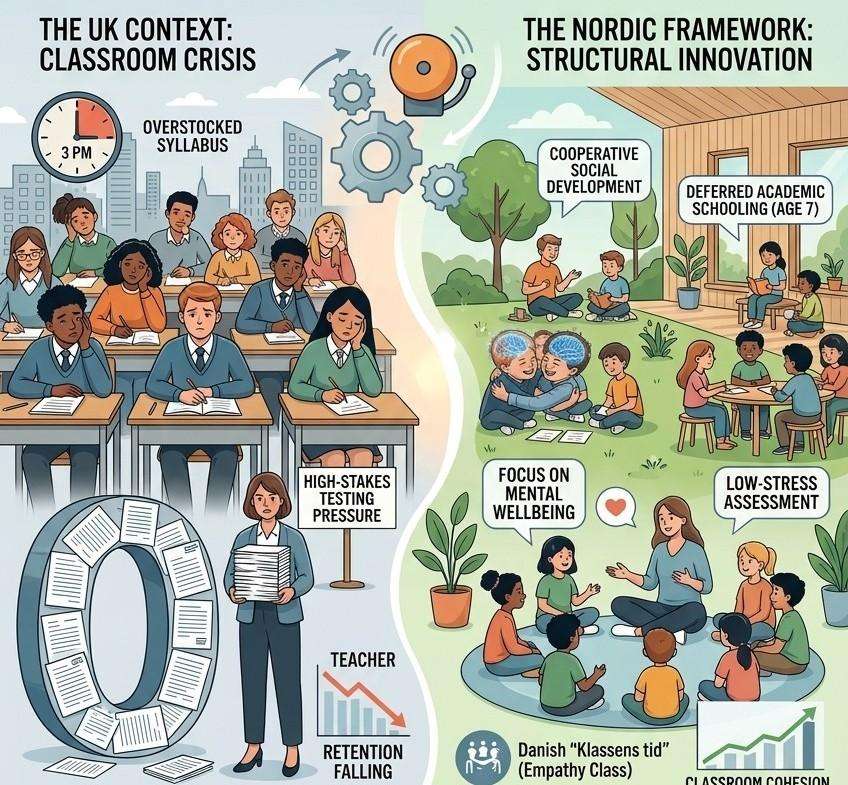
The Nordic methodology, long epitomised by the Finnish framework, operates on foundational pillars entirely antithetical to the current British setup. In Finland, formal academic schooling is legally deferred until children reach the age of seven, prioritising early cognitive play and cooperative social development. Throughout the primary and secondary cycles, standardized national testing is non-existent; the solitary major national examination occurs exclusively at the culmination of secondary education.
This structural design deliberately alleviates the systemic anxiety that characterizes the United Kingdom’s current assessment infrastructure. Furthermore, contemporary data reveals that Finnish policymakers are currently implementing a comprehensive legislative overhaul running through 2026–2027. This initiative drastically reduces bureaucratic administration for educators, shifting regional funding towards immediate, group-based inclusive support inside the classroom rather than relying on delayed clinical assessments.
A veteran London secondary school headteacher, speaking directly to this journalist, highlighted the stark contrast:
"The endless administrative paperwork and the constant pressure of upcoming inspections are driving highly qualified personnel out of the profession entirely. We are trapped in a cycle of over-testing pupils while simultaneously suffocating our instructional staff with metrics."
The Architecture of Group-Based Empathy
Simultaneously, the Danish educational framework provides a highly distinct operational blueprint regarding classroom cohesion. Since the passage of the landmark 1993 educational directives, Denmark has legally mandated weekly empathy and community-building sessions, known natively as Klassens tid, for all pupils aged six to sixteen. This is not an optional extracurricular activity but a core curricular requirement where youth collectively negotiate interpersonal disputes and foster emotional regulation.
According to verified comparative datasets, this deliberate focus on collective accountability correlates directly with significantly lower reported rates of adolescent bullying and higher overall workplace retention figures in adulthood. Crucially, up to 60 per cent of all secondary school tasks within the territory are strictly team-based, structurally hardwiring collaborative problem-solving into the population.
Mitigating the Domestic Infrastructure Strain
For a British education sector currently facing severe deficits, a critical look via the Daily Dazzling Dawn reveals that replicating these systems involves significant structural hurdles. Analysts point out that the Nordic model relies heavily on its specific cultural context, including low socioeconomic inequality and a robust social safety net. Replicating the exact system is difficult for larger, more complex economies with different funding structures.
Furthermore, recent global data indicates that even the celebrated Finnish framework is facing its own modern difficulties. The most recent Programme for International Student Assessment (PISA) metrics show a marginal but steady downward trend in national reading and mathematical proficiency index points over the last decade. This drop has sparked intense internal debates in Helsinki regarding digital distractions and shifting domestic demographics.
Despite these foreign headwinds, Westminster reformers argue that localized adaptation, rather than exact replication, remains the most viable path forward to combat the domestic classroom crisis. The immediate legislative focus is now shifting toward reducing the frequency of primary school assessments and establishing mandatory mental health resilience hours within the national curriculum by the upcoming academic cycle.