.jpg)
.jpeg)



.svg)
Sylheti, a language arguably older than Bengali, remains unrecognised in Bangladesh. A country which was fueled by public protest against language marginalisation in it's fight for liberation, is yet to recognise the Sylheti language. A country which is exclusively Bengali in its delivery of media and education, is yet to recognise the Sylheti language.
These are the sentiments felt by the Sylheti language activists. They feel enough is enough and a fight for change is essential for their linguistic and cultural survival. It is these Sylhetis who envisage a heterogeneous Bangladesh prospering in diversity, not aggressing in adversity.
Following the fall of Hasina's ethno-nationalistic oppressive regime, the Sylheti activists were given a glimmer of hope. For once, they can breathe with confidence and express their Sylheti identity without being told "you are Bengali, you speak a Bengali dialect". The July Charter is the lifeline which has been handed to all of Bangladesh's minoritised ethnic identities and linguistic groups.
In Tarique Rahman's message on the occasion of International Mother Language Day he stated that "Bangla is the Main Vehicle of Our ldentity". This was received by many minoritised language groups as an aggressive tactic to maintain the status quo left behind by the Awami League. It is a strategy to forcefully assimilate minority groups, going as far back as to when MP Manabendra Narayan Larma rejected this forced assimilation when Mujibur Rahman told the Chakma MP that "we are all Bengali, forget your identity, become Bengali".
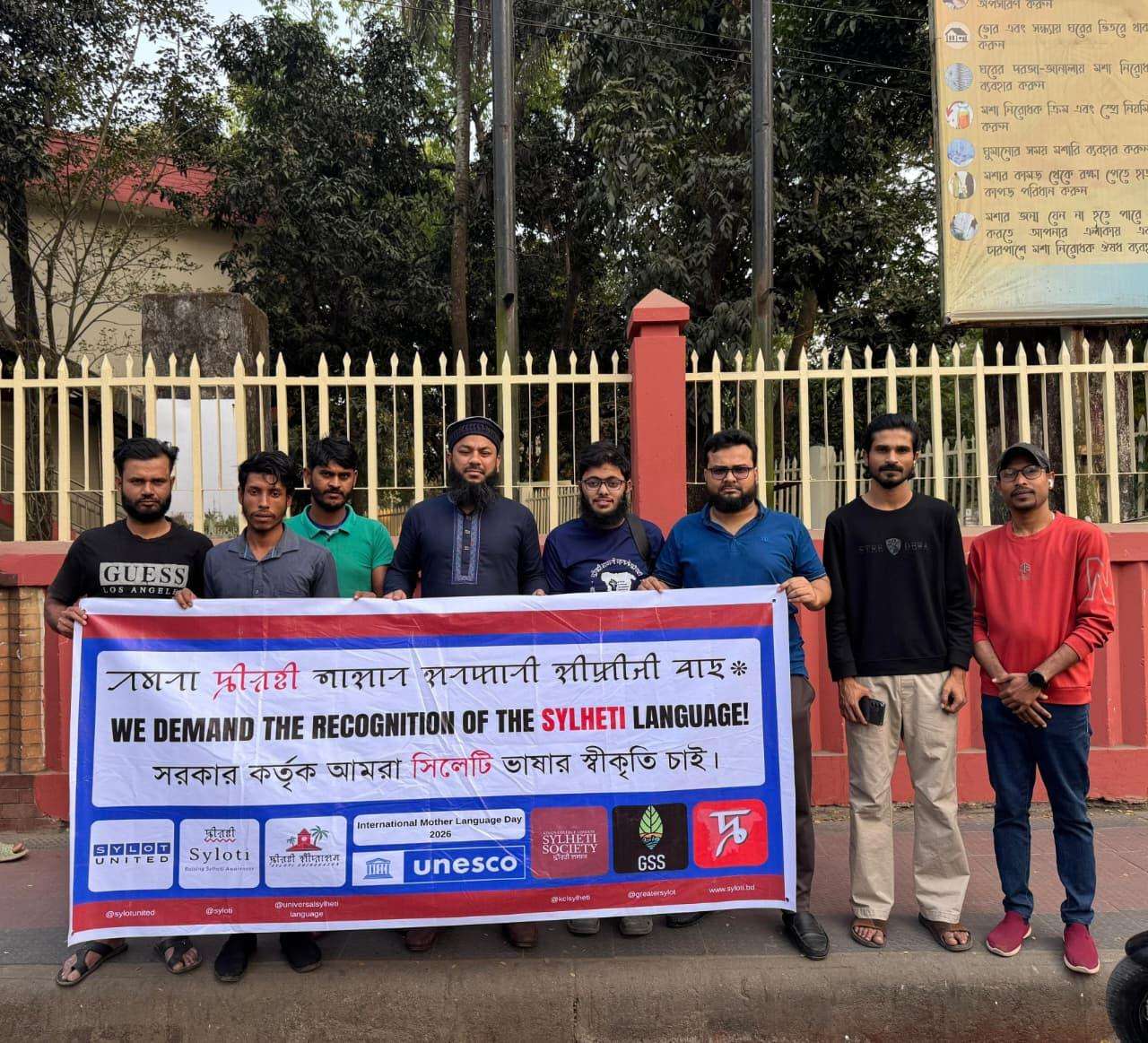
The activists decided to stand in solidarity of their mother language outside Sylhet City Corporation, Bondor Bazar, and near to the Sylheti Nagri Chottor, a monument dedicated to the Sylheti script. It is a script which got wiped out of existence following the mysterious burning down of the last remaining printing establishment, Islamia Printing Press in Bondor Bazar which was founded by Munshi Moulvi Abdul Karim in 1869, on his return from London.
Five Family Members, Including Expatriate’s Wife and Children, Throat-Slit to Death in Bangladesh
The Sylheti language activists are well-informed on the history of their script and language, compared to the average Sylheti. For this reason they are very active online in campaigning to raise awareness so their fellow people join their call and help save Sylheti. They feel that such a beautiful script of a language that is recognised by multiple international bodies must be recognised as part of Bangladesh's cultural diversity. It is already recognised by Unicode (ISO 639-3 code: syl) and is being used by the Sylheti community around the world thanks to the default availability in Android devices since it is recognised by Google. Meta also recently recognised Sylheti and people are now able to list Sylheti as their language on Facebook.
What made this march powerful was the usage of this script across their banner which read "ꠀꠝꠞꠣ ꠍꠤꠟꠐꠤ ꠜꠣꠡꠣꠞ ꠡꠞꠇꠣꠞꠤ ꠡꠤꠇ꠆ꠞꠤꠔꠤ ꠌꠣꠁ" (we demand Government recognition of the Sylheti language).
They also included the Bengali version in the Purbi Nagri script "সরকার কর্তৃক আমরা ছিলটি ভাষার স্বীকৃতি চাই।."
They accept Bengali as their state language, but they demand recognition and implementation of the Sylheti language in Sylhet Division as part of protecting their cultural and linguistic heritage. Who can deny that they don't have a right to demand such things? Denying this would go against the spirit of International Mother Language Day and the same language martyrs that the State was remembering. It's for this reason the Prime Minister's comments were met with deep hurt and betrayal, especially due to his biggest backers being the Sylheti people (as reflected by the election results in Sylhet Division where 18/19 were won by the BNP). The Sylhetis are also aware that their British diaspora in London played a major role in Tarique Rahman being able to thrive and keep his party's hopes alive while being in self-imposed exile in the UK.
The Sylhetis are a resilient people, history reminds us. They fought with valour against the British in the Sylhet Uprising 1782 at Shahid Eidgah and as they did in the 1971 liberation war under the Sylheti General, MAG Osmani. They are a proud people, who sat silent for far too long, while the pride of others was expressed and imposed over them.
Yesterday's march was for recognition of the Sylheti language, tomorrow's one will be for their dignity. Their struggle has only just begun in Bangladesh 2.0. As a proud people of the People's Republic of Bangladesh, the Sylhetis contributed and sacrificed much for their nation and they will continue to do so. The time has now come for the state to be dignified towards them. Implementation of the July Charter is a must. Long live Sylheti language! Long live all languages of Bangladesh!