






.svg)
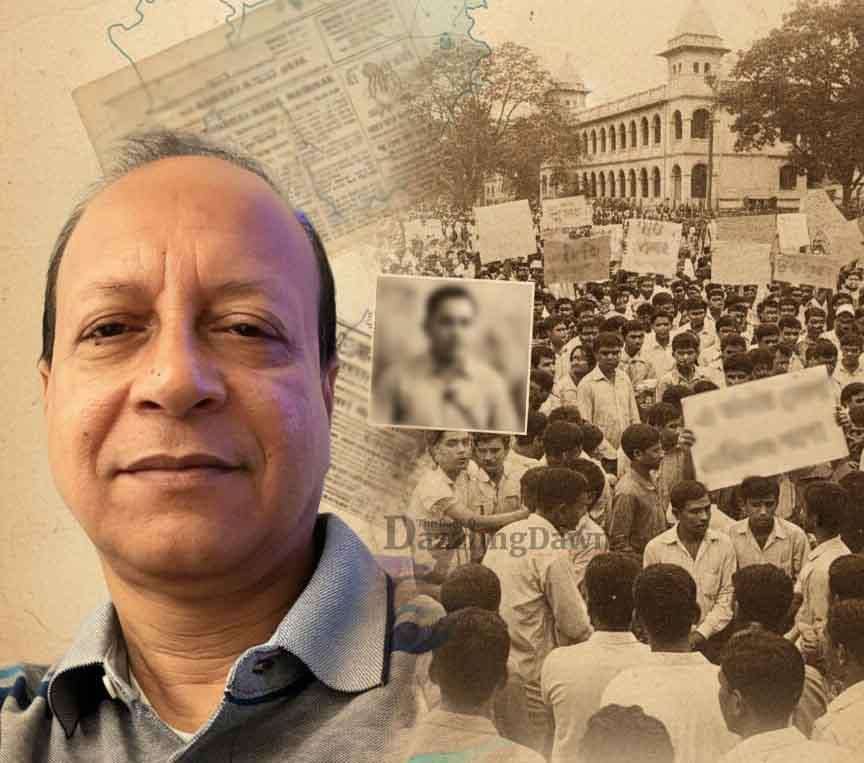
In our history, the Language Movement stands unparalleled in its multi-dimensional appeal. The 21st of February, an eternal source of consciousness in the nation’s journey, is now observed as International Mother Language Day. In this crucial chapter of national history, the luminous participation of the people of Sylhet reflects the region’s distinctive vitality.
The powerful tide of the Language Movement spread across the soil of Sylhet as well. Owing to its regional particularities, Sylhet had long possessed a distinct, somewhat different character. During Rabindranath Tagore’s visit to Sylhet in 1919, one of the principal invitational speeches at his civic reception was delivered in Urdu. At that time, Sylhet was steeped in a deeply conservative environment. Yet gradually, the people of Sylhet were able to overcome much of that conservatism. On the question and demand of the mother tongue, the people of Sylhet stood in the very front ranks of the movement. In September 1947, Tamaddun Majlish published a booklet entitled ‘Pakistan’s State Language: Bengali or Urdu?’ From 1947 onwards, the state language debate became a living issue in Sylhet. The question was raised repeatedly in meetings, gatherings, and seminars.
At that time, the state language movement had not yet begun elsewhere in East Pakistan. Only later, in February or March 1948, did the demand for Bengali as a state language arise in Dhaka and other parts of East Pakistan. In Sylhet, however, the call for Bengali as the state language—first voiced by conscious poets, writers, litterateurs, and intellectuals—soon transformed into a people’s demand. A significant role in Sylhet’s Language Movement was played by the weekly newspaper Naobelaal, published from Sylhet. It began publication on 1 January 1948. Its publisher and chief editor, Mahmud Ali, was a politician who launched the paper primarily as a platform for political engagement. The editor was Dewan Mohammad Azraf. Naobelaal carried news of the central movement while also publishing reports of Sylhet’s own language activism.
From late 1947 onwards, the movement spread among the educated circles of Sylhet town. The Muslim Sahitya Sangsad of Sylhet initiated discussions to build public opinion among the educated classes in favour of Bengali as the state language. Its mouthpiece was Al-Islah. In its August 1947 issue, an editorial declared: ‘We can never support the adoption of any language other than Bengali as our state language.’ Language activist Abul Maal Abdul Muhit, in his memoir Smriti Amlan 1971, wrote that Sylhet had been particularly active on the language question from the very beginning—perhaps owing to more than a decade of dedicated work by the Central Muslim Literary Society.
Under the initiative of the literary society, discussions on the state language question were held in Sylhet on 9 and 30 November, and 28 December 1947. On 9 November, the Central Muslim Literary Society, Sylhet, convened a meeting in its own hall demanding that Bengali be recognised as Pakistan’s state language. Educationist and writer Muslim Choudhury presented a keynote paper titled ‘Pakistan’s State Language’. On 30 November, the distinguished writer and linguist Syed Mujtaba Ali delivered a long and reasoned speech at the Alia Madrasa Hall in Sylhet, presenting cogent arguments in favour of Bengali as the state language. On 28 December, philosopher Dewan Mohammad Azraf presented his paper. In his address, Syed Mujtaba Ali stated that imposing Urdu as the state language upon Bengal would be sheer folly. His speech was later published in 1949 as a book entitled ‘The State Language of East Pakistan’. For this stance, he later faced considerable harassment.
In Sylhet, there were also many who opposed the recognition of Bengali as the state language. Among them were Azmal Ali Choudhury, Taimur Raja Dewan, Abdul Majid, Maulana Jamirul Haque, and Moinuddin Ahmed Choudhury. Gradually, the movement moved beyond the quiet confines of the Central Muslim Literary Society to the historic Gobindacharan Park of Sylhet (now Hasan Market), where direct mass mobilisation began. Meetings and rallies in favour of the Bengali language were held there. Gobindacharan Park played a historic role in Sylhet’s Language Movement. Located in Bandar Bazar, it was once the epicentre of Sylhet’s political and social movements, much as Court Point and the Registry Field serve today. In 1959, the present Hasan Market was constructed on the site. Now owned by the Sylhet City Corporation and serving as a shopping complex for lower- and middle-income groups, it bears no memorial to the historic park. Consequently, many in the younger generation remain unaware of this important chapter of history.
On 11 January 1948, when Pakistan’s Communications Minister Abdur Rab Nishtar visited Sylhet, local Muslim Student Federation leaders, including its president Abdus Samad, presented him with a proposal demanding Bengali as a state language. Their efforts proved unsuccessful. Around the same time, a delegation of women met the minister to press the issue, but without result. On 22 February 1948, distinguished women of Sylhet sent a memorandum to Chief Minister Khawaja Nazimuddin, demanding recognition of Bengali as a state language. Among the signatories were Zobeda Khatun Chowdhurani, Shahera Banu, and Syeda Lutfunnessa. On 23 February 1948, when Constituent Assembly member Dhirendranath Dutta proposed that Bengali be recognised as a state language, the proposal was opposed by Muslim League members led by Tamizuddin Khan, and dismissed following Nazimuddin’s speech. In response, students in Sylhet, like those in Dhaka, rose in protest.
Following the Central State Language Action Committee, programmes began in Sylhet from early March 1948. On 8 March, a public meeting demanding Bengali as the state language was held at Gobindacharan Park, organised by Tamaddun Majlish and the Muslim Student Federation, with Mahmud Ali presiding. The meeting was violently disrupted by extremist elements of the Muslim League. Student leader Maqsud Ahmed was severely beaten; Dewan Mohammad Azraf, Abdus Samad, Dewan Wahidur Reza, and several others were injured by brickbats. A counter-meeting in favour of Urdu was held under the chairmanship of M. A. Bari (Dhola Miah), who, notably, later supported Bengali from 1951 onwards. In protest against this violence, the Sylhet District Women’s Muslim League called a meeting at Gobindacharan Park on 10 March. However, shortly before it began, the Additional District Magistrate imposed a two-month ban on all meetings related to the state language question, citing rising tensions. As a result, no programme was observed in Sylhet on 11 March. In protest, Dewan Wahidur Reza of Tamaddun Majlish and Mohammad Abdus Samad of the Muslim Student Federation issued a statement in Naobelaal. Eighteen prominent citizens of Sylhet also issued a joint statement that day.
When Muhammad Ali Jinnah visited Dhaka and declared on 21 and 24 March that ‘Urdu alone shall be the state language of Pakistan’, students protested. In Sylhet, too, students expressed their dissent, albeit on a more limited scale. On 27 January 1952, when Nazimuddin reiterated that Urdu would be Pakistan’s state language, students and citizens in Sylhet erupted in protest. A State Language Action Committee was formed in Sylhet under the convenorship of Pir Habibur Rahman, with members including Mahmud Ali, Nurur Rahman, Monir Uddin Ahmed, Hajera Mahmud, Syed Motahar Ali, and Abdur Rahim. On 21 February 1952, news reached Sylhet by telephone that police had opened fire on unarmed students in Dhaka. The city immediately roared in protest. Several leaders resigned from the Muslim League in condemnation, including Mahmud Ali, Abdur Rahim, A. Z. Abdullah, and Matsir Ali. The city observed a full strike; slogans filled the streets: ‘We demand Bengali as the state language’, ‘Justice for the slain students’, ‘Punish the killers’, ‘Resign the cabinet’.
On 22 February, a mass meeting at Gobindacharan Park, presided over by Advocate Mohammad Abdullah B.L., paid tribute to the martyrs and called for a full strike the following day. Merchants observed a complete shutdown. A solemn procession wound its way through the city that evening. Women’s meetings were also held, led by Zobeda Khatun and Begum Hajera Mahmud, voicing fierce protest and reaffirming the demand for Bengali. The final public meeting of this phase in Sylhet was held on 5 March at Gobindacharan Park, presided over by Advocate Abu Ahmad Abdul Hafiz, with speeches by Mahmud Ali, Dabir Uddin Ahmed Choudhury, Tera Miah, Moazzam Ahmed Choudhury, Abdul Bari, Abul Maal Abdul Muhit, and Matsir Ali.
The Language Movement spread across the entire Sylhet region—Beanibazar, Shaistaganj, Balaganj, Golapganj, Zakiganj, Baniachang, Fenchuganj, Bishwanath—reaching sub-divisions, police stations, unions, and remote villages. In its second phase, Naobelaal played a vital role, publishing regular reports from January to April 1952. Through this Language Movement, we came to recognise our distinct identity; and it was through that awakened consciousness that we eventually attained our independence.
Compiled: Toufique Chowdhury.
Sources and Acknowledgements:
Badruddin Umar, The Language Movement of East Bengal and Contemporary Politics; Ahmad Ishtiaq, The Daily Star Bangla; Abdul Hamid Manik, Background of the Language Movement in Sylhet; Ahmed Rafique, The Language Movement from Teknaf to Tetulia; Daily Azad.



.jpg)