


.svg)
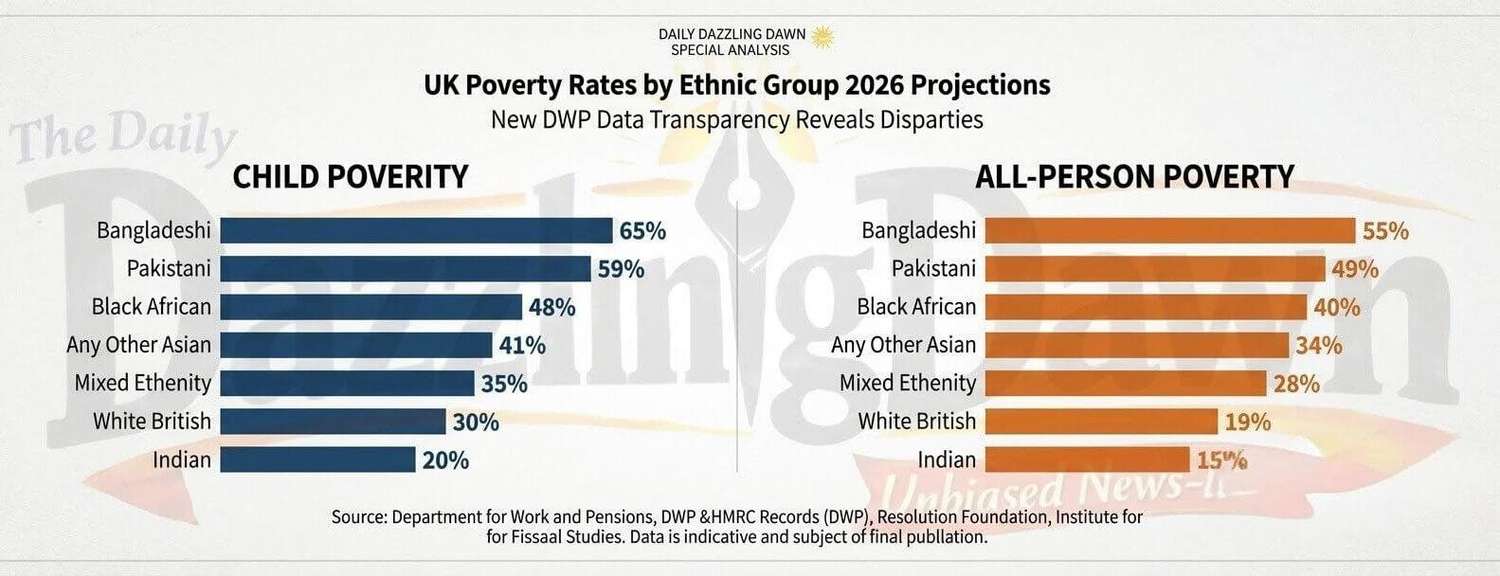
A massive overhaul of UK poverty data coming this March will finally expose the true scale of financial hardship within British Bangladeshi and Pakistani households, Daily Dazzling Dawn understand.
Beyond the Survey The New Era of Poverty Transparency-The Department for Work and Pensions (DWP) is set to abandon its reliance on self-reported surveys in favor of "administrative datasets"—direct links to HMRC tax records and benefit payments. While the government suggests this may lower the official headline figure of 4.5 million children in poverty due to previous "under-reporting" of benefits, a deeper special analysis reveals a darker trend for ethnic minorities. For decades, the true depth of "very deep poverty" in Asian Muslim communities has been masked by data gaps. The March 2026 revision is expected to show that while some households may move slightly above the relative low-income line, the "material deprivation" for British Bangladeshi and Pakistani children remains at a record, stagnant high.
Read more: Tulip Siddiq Case Takes Turn on First Day of Bangladesh’s New Government
The Bangladeshi Crisis Why the Most Affected Group Faces a Critical Year-Current figures place the British Bangladeshi community in the most precarious position in the United Kingdom, with a staggering 65% of children living below the poverty line. Despite significant gains in educational attainment—where Bangladeshi students now outperform many peers—the "broken social mobility promise" means these qualifications are not translating into higher wages. This "ethnic penalty" in the labor market, combined with the fact that 68% of Bangladeshi adults live in households where not all members are employed, has created a cycle of persistent low income that national averages fail to capture.
British Pakistani Families and the Two Child Cap Bonanza-For British Pakistani families, 59% of whom currently live in poverty, the focus shifts to the government’s recent decision to scrap the two-child benefit limit. With 41% of Pakistani families having three or more children—compared to just 14% of White British families—this policy shift is being hailed by some as a "financial bonanza" and by others as a vital lifeline. Projections suggest that the removal of this cap will disproportionately benefit this demographic, potentially lifting tens of thousands of Pakistani children out of absolute poverty by the end of 2026.
The Hidden Hunger Crisis in British Muslim Communities-Recent socio-economic studies published in February 2026, including the "Crisis of Belonging" report, highlight a "hidden hunger" within the wider British Muslim community that government statistics still struggle to track. Nearly 30% of British Muslims are currently struggling to pay essential household bills, yet an estimated 95% of those in financial difficulty do not seek state or charitable help. This "invisible poverty" is particularly acute among Black African Muslims, where 1 in 5 reported going hungry in the past year. As the DWP moves to a more data-driven approach, the gap between "official income" and the "lived reality" of food insecurity remains a primary concern for community leaders.
The Road to the 2029 Election-The government’s upcoming Child Poverty Strategy, due for a major update following the March data release, will face immediate scrutiny. Critics argue that simply "correcting the numbers" to reflect benefit income does nothing to address the root causes: high housing costs in London and the West Midlands, and the persistent employment barriers facing Muslim women. As we move into the second half of 2026, the focus will shift from how many people are "on benefits" to how many are "trapped in low-pay." The DWP’s new "Deep Material Poverty" measure, launching next month, will be the true test of whether Sir Keir Starmer’s government can move beyond statistical adjustments to real-world relief for the UK's most vulnerable ethnic groups.
Read also: British Couple Jailed 10 Years in Iran