

.jpg)


.svg)
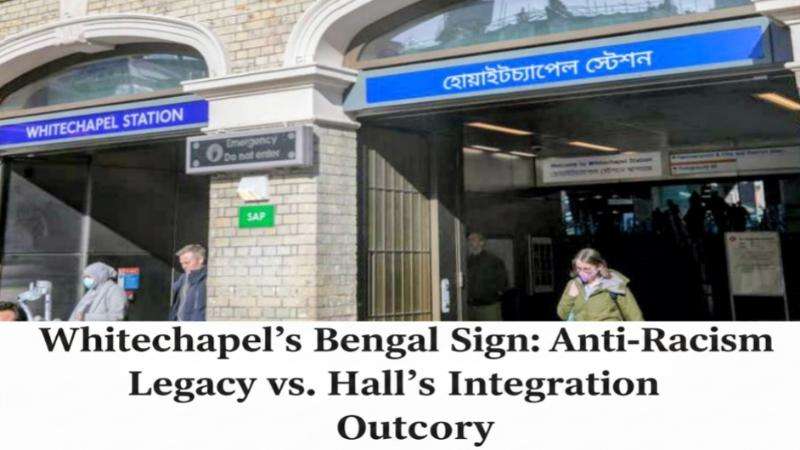
Despite new attempts being made to create controversy surrounding the bilingual sign—displayed in both English and Bengali—at Whitechapel station, British Bangladeshi-origin MPs and leaders have remained silent.The bilingual sign at Whitechapel station—displaying the name in both English and Bengali—has ignited a sharp debate, exposing a deep fissure between those who celebrate London's multicultural tapestry and those who cling to a singular, mono-cultural vision of Britain. The controversy centres on a tweet by former Conservative mayoral candidate Susan Hall, who slammed the signage as "Unacceptable" and demanded that residents "must learn the language and dare I say 'integrate'." Her comments drew an immediate and robust defence from the Mayor of London, Sadiq Khan, whose office stated unequivocally: "London’s diversity is its greatest strength... The Mayor is proud of all of the different cultures that make the capital the best city in the world, Daily Dazzling Dawn realised.
Altab Ali’s Legacy: The British Bangladeshi Anti-Racism Vanguard-Ms. Hall's criticism, framed as a call for linguistic conformity, completely disregards the profound historical and social context of the Whitechapel area. This is not merely a symbolic gesture, but a tangible recognition of a community that has profoundly shaped the East End and led a pivotal anti-racism movement in the UK.
The 1970s and 1980s saw a surge in racist attacks, predominantly targeting the British Bangladeshi community in East London. This era reached a tragic crescendo with the brutal, racially motivated murder of 24-year-old textile worker Altab Ali in Whitechapel in 1978. His death, and the subsequent failure of authorities to stem the tide of violence, spurred the community into a mass mobilisation. Just ten days after his murder, an estimated 7,000 Bengalis and anti-racist allies marched with Ali’s coffin from the East End to Downing Street. This event, and the ongoing campaigns it inspired, became a watershed moment, decisively turning the tide against the fascist National Front's attempts to establish a foothold and marking the British Bangladeshi community as one of the UK’s most determined vanguards of anti-racism.
A Demographic Reality: East London's Bengali Heart-The signage is a reflection of Whitechapel’s demographic reality. According to the 2021 Census data, Tower Hamlets is home to the largest Bangladeshi population in England and Wales, with an impressive 34.6% of its overall population identifying as such. Specifically within the Whitechapel ward, the proportion is even higher, with 38% of residents being of Bangladeshi ethnicity. The signs, installed and entirely funded by Tower Hamlets Council in March 2022, recognise the community’s contribution, heritage, and ongoing presence.
Beyond Bangla: A Precedent of Bilingual Recognition-The insinuation that Whitechapel's Bengali sign is an anomaly that undermines "English-only" culture is historically and factually incorrect. The UK transport network has long recognised the need for multilingual signage to serve its diverse communities. For instance, London’s Southall station, also on the Elizabeth Line, has bilingual information prominently displayed in English and Punjabi (Gurmukhi script), acknowledging its large Punjabi population since the 1990s. While Southall and Whitechapel are prominent examples of bilingual transport signage in Asian scripts, there are other instances of non-English language signage, such as bilingual signs in Hindi at Leicester station proclaiming 'Welcome you to Leicester' (लैस्टर आपका स्वागत करता है). The Whitechapel station sign is, therefore, part of a precedent of recognising local linguistic communities, but it stands as a unique and powerful monument to the British Bangladeshi struggle.
Theatrical artist and one of the prominent leaders of Britain's anti-racism movement, Shadin Khosru, said: "The Bengali sign at Whitechapel is not a replacement for English; the English signage at the station is clearly maintained. It is an addition, a gesture of respect that acknowledges the lived experiences and history of a community that has given much to Britain and fought hard for their place. He further added that "This Bengali sign is not a first-time target; it has repeatedly been the victim of racist comments in the past.'
The Silence of Leadership vs. The Mayor’s Pride-Ms. Hall’s comments—calling the dual-language sign "Unacceptable"—are a politically opportunistic and deeply flawed attempt to weaponise immigration rhetoric for electoral gain. Her action of deleting the divisive post on X, formerly Twitter, demonstrates an awareness of its toxicity, yet fails to undo the damage of its sentiment.
By contrast, Sadiq Khan’s office offers a far more constructive and realistic view of modern London. The Mayor’s defence of multiculturalism is not an attack on the English language, but an embrace of a richer, more resilient national identity. The Whitechapel sign is not a replacement for English; the station retains its clear English signage. It is an addition, a gesture of respect that acknowledges the lived experiences and history of a community that has given much and suffered for its place in Britain. The sign is a powerful retort to the 'go back home' mentality that fuelled Altab Ali's murder.
Despite the sign's significance and the furore surrounding Ms. Hall’s comments, it remains a striking observation that, as Daily Dazzling Dawn publishes this news story, no British Bangladeshi MPs or significant community leaders have yet spoken out to publicly support the sign and challenge the narrative of cultural division. Their silence is a missed opportunity to reinforce the powerful and enduring message of resistance and recognition that the Bengali signage embodies.