

.jpg)


.svg)
There was a time when British-Bangladeshis involved in mainstream politics in the United Kingdom—particularly elected councillors and holders of other important public offices—maintained a visible distance from Bangladesh’s partisan politics. Many openly sympathised with or supported political parties such as the BNP, Jamaat-e-Islami, or the Awami League. Yet, because they were actively engaged in British politics, they generally refrained from taking part in party programmes, campaigns or demonstrations related to Bangladesh. Their support remained intellectual, personal or behind the scenes.
However, over the last couple of years, a noticeable shift has emerged. A number of British-Bangladeshi politicians who hold elected office in the UK have become increasingly active in Bangladeshi party politics while continuing to serve as councillors. During Bangladesh’s parliamentary election held on 12 February, at least five sitting councillors from Britain reportedly travelled to Bangladesh to pursue political ambitions and campaign activities. The issue attracted considerable media attention and was even highlighted by The Guardian.
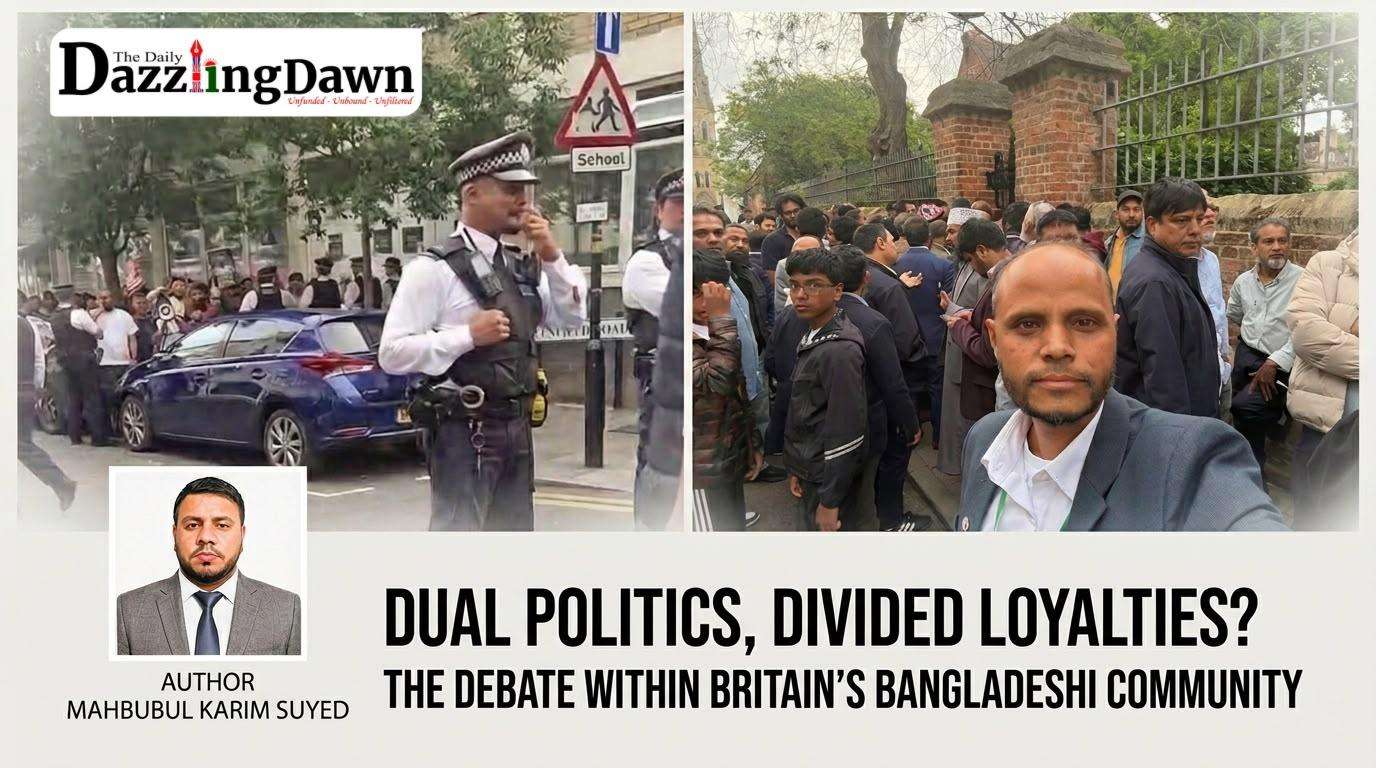
Mistaken Identity: Man at London Event Misidentified as War Criminal Chowdhury Mueen-Uddin
The matter was first explored in an analytical piece published by Spiked on 31 October 2025. This was followed by reports in The Guardian on 13 November 2025 and Local Government Lawyer on 14 November 2025. These reports focused on the UK government’s concerns over several British-Bangladeshi councillors from Tower Hamlets seeking to participate in Bangladesh’s parliamentary politics.
According to The Guardian, the UK government viewed the matter seriously enough for Communities Secretary Steve Reed to convene discussions with the commissioners overseeing Tower Hamlets Council. The newspaper noted that these political ambitions emerged against the backdrop of existing concerns about governance, transparency and political culture within the council. As such, the issue extended beyond individual aspirations and touched on wider questions of public trust and local governance.
Local Government Lawyer reported that Tower Hamlets councillors Sabina Khan and Wahid Ahmed had been actively campaigning to contest Bangladesh’s parliamentary elections as candidates of the Bangladesh Nationalist Party (BNP), despite continuing to hold elected office in London. Steve Reed described the situation as both “disappointing” and “unacceptable”, arguing that councillors are elected primarily to serve their local communities. Nevertheless, the report also clarified that under current UK law, contesting elections abroad does not automatically disqualify someone from remaining a councillor.
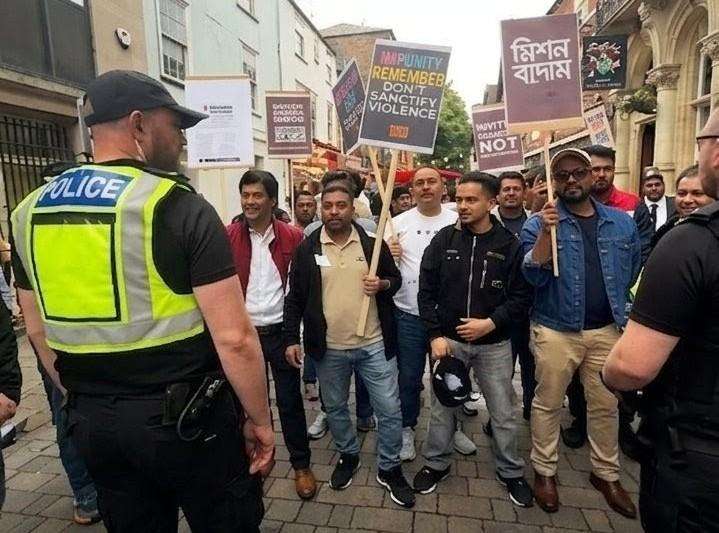
Crowds Gather to Welcome Hasnat Abdullah and Shadik Kayem in Oxford; Awami League Protests
Conversations with individuals active within the British-Bangladeshi community suggest that many do not view this growing trend positively. While they acknowledge that involvement in Bangladeshi politics may benefit the individuals concerned, they fear that the broader community could suffer reputational damage.
Several people, citing the Guardian’s reporting, expressed concern that younger fourth-generation British-Bangladeshis entering mainstream British politics may face difficult questions about divided loyalties and political priorities. Some even worry that such controversies could discourage young people from pursuing public office altogether.
Moreover, this phenomenon did not end with Bangladesh’s last parliamentary election. Its effects are still unfolding.
During the current UK visit of Bangladeshi Member of Parliament Hasnat Abdullah and Dhaka University Central Students’ Union Vice-President Abu Sadiq Kayem, a number of sitting councillors have actively participated in welcoming events and rallies. Some have not only joined demonstrations but have also used social media and public platforms to attack political opponents and display their allegiance.
Previously, such activities were largely concentrated in East London. Increasingly, however, this trend appears to be spreading to other cities across the UK. The recent visits of Hasnat Abdullah and Sadiq Kayem have brought into focus the involvement of elected representatives outside London as well.
Frankly, many of us feel embarrassed by the spectacle of diaspora activists reproducing the divisive culture of Bangladeshi party politics on British soil.
In the past, whenever a Bangladeshi Prime Minister visited the UK, opposition supporters would gather outside hotels or meeting venues, sometimes leading to egg-throwing, scuffles and disorder. Sadly, the situation appears to have worsened. The arrival of a parliamentarian and a student leader recently sparked rival demonstrations, aggressive slogans and physical confrontations in Oxford—a city internationally renowned for learning and civility. Similar scenes unfolded in East London, where police were seen carrying away several individuals under arrest.
I asked Wahid Ahmed, a former student leader in Bangladesh and now an active figure in British mainstream politics, for his perspective. He told me:
“My view is that those who have worked within the systems of the UK or other developed democracies, gained valuable experience, and wish to contribute towards building an honest, efficient and self-reliant Bangladesh should be encouraged rather than discouraged.
This is beneficial not only for the individual but for the country as a whole. Experience of governance, accountability and public service acquired in mature democracies can help bring positive change to Bangladesh.
At the same time, I believe it is essential to have a transparent and fair framework. Clear rules would prevent misunderstandings and protect the reputation of the community. Experienced individuals should be allowed to contribute, but that opportunity must be managed transparently and responsibly.”
I also posed a question to Barrister Saifuddin Khaled, a prominent London lawyer, former Speaker of Tower Hamlets Council and former councillor: Should an elected British councillor simultaneously play an active role in Bangladesh’s national politics? Critics argue that doing so raises questions about accountability and priorities. Is this concern justified, or should it be viewed as part of diaspora democratic rights?
Barrister Khaled replied:
“In my view, a British councillor’s interest or participation in Bangladeshi politics is not automatically problematic. Members of the diaspora have democratic rights to express opinions and engage with the political and social affairs of their country of origin.
However, the concerns of critics cannot be dismissed outright. A councillor’s primary responsibility is to represent and serve their local constituents. If their time, attention or political priorities become so divided that residents feel inadequately represented, questions of accountability naturally arise.
Therefore, the issue is not dual engagement itself but rather the ability to fulfil responsibilities and maintain transparency. If a councillor performs their local duties effectively while remaining active in Bangladeshi affairs, I would regard it as part of their democratic rights as a member of the diaspora. But if local representation suffers, then the criticisms become entirely legitimate.”
My humble appeal to those who are active in British politics or hold elected office is simple: please do not become part of the problem by importing Bangladesh’s partisan conflicts into Britain while serving in public office here.
No one is questioning anyone’s patriotism or desire to contribute to Bangladesh. But if you wish to pursue active party politics in Bangladesh, consider stepping down from your elected position in the UK—or wait until your term has ended.
The British-Bangladeshi community has worked hard for decades to build its reputation. It would be unfortunate if that legacy were overshadowed by political ambitions pursued across borders at the expense of public trust.
--
Author: A British-Bangladeshi based Columnist in Luton, United Kingdom.