



.svg)
Artificial intelligence is opening new doors for historians by helping decipher mysterious coded manuscripts that have remained unread for centuries in libraries and archives around the world.
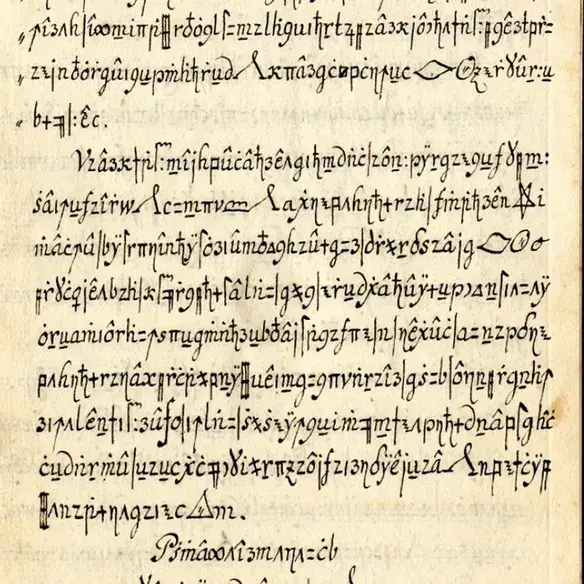
One remarkable example is the Borg Cipher, a 408-page handwritten manuscript preserved in the Vatican Library. Filled with unusual symbols, scattered Roman letters, and an Arabic title page, the document had puzzled researchers for more than 400 years. Historians believed it contained secret medical remedies that were deliberately concealed to avoid accusations of witchcraft or suspicion during the period in which it was written.
Using machine learning techniques, researchers successfully decoded the manuscript, revealing thousands of medical treatments and remedies. Among the unusual recommendations were consuming high-quality red wine and preparing fermented nutmeg mixtures to treat illnesses such as dysentery.
Professor Beáta Megyesi, a computational linguist at Stockholm University, described the process as a form of historical detective work. She explained that every symbol, pattern, and partial breakthrough helped researchers move closer to understanding the hidden world preserved within the manuscript.
The successful decoding of the Borg Cipher has inspired broader efforts to use artificial intelligence in cracking historical codes. Researchers estimate that around 1% of documents stored in archives and libraries worldwide remain partially or fully encrypted, potentially containing valuable information about diplomacy, medicine, secret societies, personal relationships, and political events.
Some decoded documents have already changed historical understanding. Recently, a collection of encrypted letters written by Mary, Queen of Scots, revealed new details about her political ambitions, attempts to regain power, and strained relationship with her son, who later became King James I of England.
However, deciphering ancient codes remains a difficult task. Historical ciphers often contain misleading symbols, multiple representations for a single letter, or even unknown languages. Researchers must first convert handwritten documents into digital text before any decoding can begin, a process complicated by fading ink, damaged pages, and difficult handwriting.
Artificial intelligence is helping speed up this work. Tools such as Transkribus can automatically recognize and transcribe historical handwriting from different languages and centuries. Recently, researchers used the technology to digitize a secret letter written during the Thirty Years' War by Sigismund Heusner von Wandersleben to Swedish Chancellor Axel Oxenstierna.
While current AI systems perform well with many historical texts, they still face challenges when dealing with unusual symbols or custom-made cipher characters. To address this, international researchers involved in the Descrypt project are developing more advanced AI models capable of handling a wider variety of scripts, alphabets, and symbolic systems.
Once documents are transcribed, cryptologists use specialized software and statistical analysis to identify patterns and uncover hidden meanings. Even so, human expertise remains essential. Researchers often work closely with computer systems, combining historical knowledge with machine-generated suggestions to solve complex codes.
Experts believe continued advances in artificial intelligence could eventually unlock thousands of hidden documents, offering unprecedented insights into forgotten chapters of human history and bringing long-lost voices from the past back into the historical record.



.jpg)