





.jpg)
.svg)
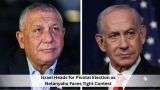
Israel is heading towards a pivotal election, with Prime Minister Benjamin Netanyahu facing a closely contested challenge from former military chief Gadi Eisenkot and his Yashar political movement. Polling suggests neither side is assured of securing the parliamentary majority needed to form a government, raising the possibility of prolonged coalition negotiations and further political uncertainty.
The election is taking place amid deep divisions over national security, the war in Gaza, relations with Palestinians and the future direction of Israeli politics. Netanyahu’s political record, ongoing corruption trial and controversial judicial reforms are also likely to feature prominently in the campaign.
The race between Netanyahu and Eisenkot is expected to be tight, according to polling cited in the report. However, winning the largest number of seats may not be enough to secure power.
Israel’s parliament, the Knesset, has 120 seats. A government generally needs the support of at least 61 members to command a majority. With several political parties competing for representation, the final outcome will depend not only on the leading candidates but also on the alliances they can build after the vote.
If neither political bloc reaches the required threshold, negotiations between parties could become decisive. Disagreements over policy, leadership and the distribution of ministerial positions may make forming a stable coalition difficult.
A failure to reach an agreement could prolong the political deadlock and increase the possibility of another election.
National security remains central to the election campaign, particularly following the Hamas-led attacks of 7 October 2023 and the subsequent war in Gaza.
Voters are likely to assess the government’s handling of security threats, the military response and the wider consequences of the conflict. Questions about responsibility for the failures surrounding the 7 October attacks have also placed pressure on Netanyahu’s leadership.
The future of Gaza, Israel’s military objectives and the situation in the occupied West Bank are among the issues likely to influence political debate. Different parties have offered competing approaches to security, Palestinian statehood and the prospects for a longer-term settlement.
Netanyahu remains one of Israel’s most influential political figures, but his leadership has faced sustained scrutiny.
His ongoing corruption trial is an important part of the domestic political debate. He denies wrongdoing, and the proceedings remain a legal matter separate from the election itself.
His government’s judicial reform proposals have also generated significant public controversy. Supporters have argued that changes are needed to rebalance the relationship between elected officials and the judiciary, while opponents have warned that the proposals could weaken judicial independence and checks on executive power.
These disagreements have contributed to wider divisions over democratic institutions, the rule of law and the limits of government authority.
The question of military service for ultra-Orthodox Jewish men is another potentially decisive issue. Exemptions and arrangements affecting ultra-Orthodox communities have long been politically sensitive, with disagreements over equality, religious autonomy and the distribution of national responsibilities.
The positions of Arab political parties could also influence coalition arithmetic. Their representation and willingness to cooperate with other parliamentary groups may affect whether either major bloc can assemble a governing majority.
With no guaranteed path to 61 seats, even smaller parties could gain substantial bargaining power during coalition negotiations.
The election result may not immediately determine who becomes prime minister. Israel’s proportional electoral system means parties must often negotiate agreements to establish a governing coalition.
If the leading blocs remain closely matched, negotiations could take weeks and expose further divisions among potential partners. A government formed through a narrow or fragile agreement could also face difficulties maintaining parliamentary support.
The outcome will therefore depend on more than the head-to-head contest between Netanyahu and Eisenkot. The distribution of seats among smaller parties, their policy demands and their willingness to enter coalition agreements will be crucial.
As Israelis prepare to vote, the election is shaping up as a significant test of the country’s political direction, security priorities and governing stability. The final result could determine not only who leads the next government but also how Israel approaches its domestic divisions and continuing regional challenges.



.jpg)


.jpg)