






.svg)
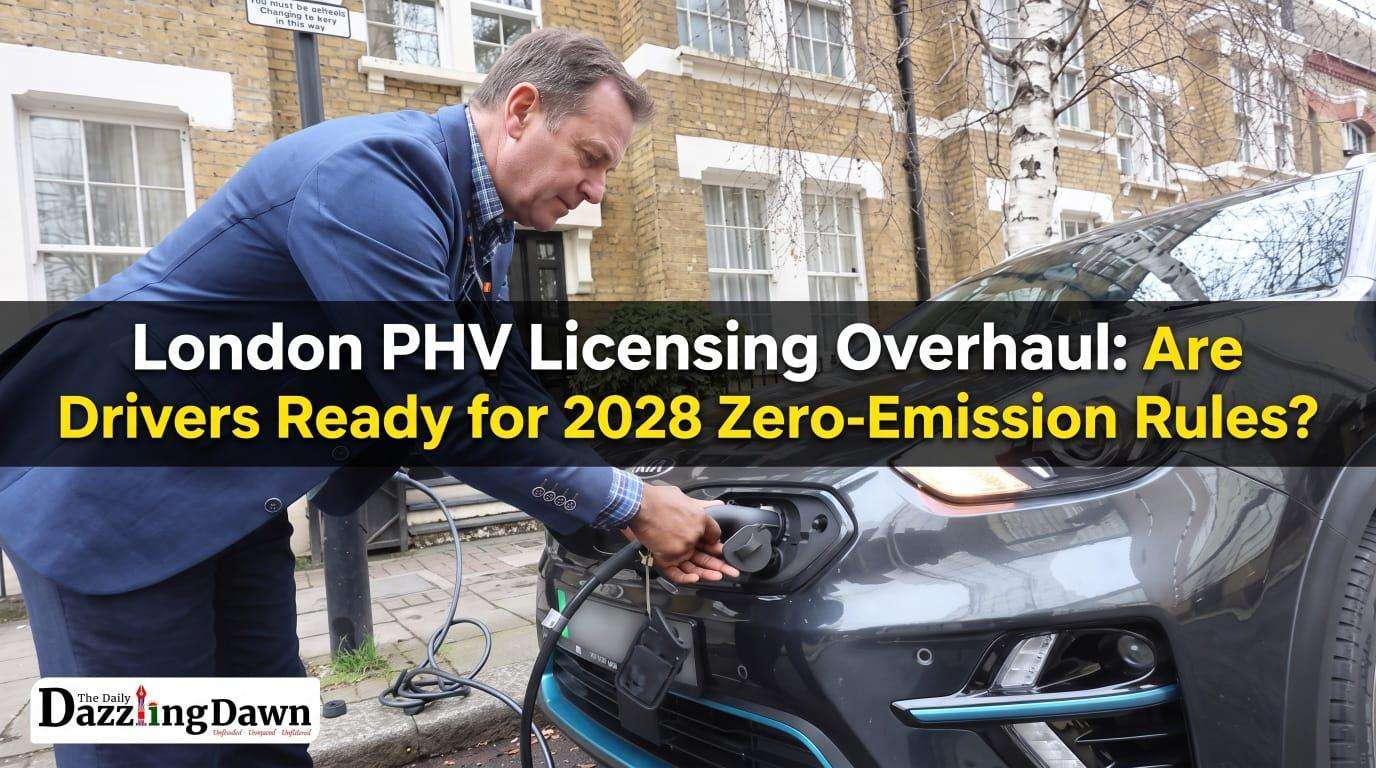
Transport for London has formally opened a public consultation proposing that all newly licensed private hire vehicles operating across London must be fully electric starting on 3 July 2028, alongside a hard 10-year vehicle age limit and stricter relicensing rules. Announced on Thursday, 22 October 2026, the regulatory overhaul aims to eliminate tailpipe emissions across the capital by replacing hybrid and zero-emission capable vehicles with battery-electric models. While standard private hire cars face the July 2028 cutoff, wheelchair-accessible private hire vehicles have been granted an extended deadline until 1 July 2030 to allow automotive manufacturers time to bring suitable accessible electric models to market.
The sweeping proposals represent a critical turning point for more than 100,000 licensed private hire drivers and fleet operators working across Greater London. Daily Dazzling Dawn understands that while over 70 per cent of the current private hire fleet in London already meets zero-emission capable standards, transport regulators remain concerned that plug-in hybrids continue to generate harmful exhaust emissions when operating on internal combustion engines. By mandating pure electric powertrains for vehicles entering the licensing system for the first time, Transport for London intends to remove fossil fuel reliance from the sector permanently.
UK Investigates Potential Cybersecurity Risks After Critical PHP Flaws Trigger Global Alert
For self-employed drivers and fleet proprietors, the immediate operational impact begins well before the 2028 electric mandate. Under the consultation framework, Transport for London plans to enforce preliminary licensing changes starting on 1 March 2027. From that date, the regulator will cease approving new alternative fuel conversion systems, specifically ending authorisations for liquefied petroleum gas and compressed natural gas modifications, as well as new exhaust abatement retrofits.
Simultaneously, the regulator is moving to tighten the administrative window for returning vehicles to service. Currently, a taxi or private hire vehicle with an expired licence can be relicensed within a 24-month grace period under existing terms. The new proposals halve this window to 12 months. Any vehicle left unlicensed for more than a year will be classified as newly presented for licensing, meaning that after 3 July 2028, a conventional hybrid car whose licence lapses for over a year would be permanently barred from returning to London roads as a private hire vehicle. Furthermore, a strict 10-year maximum age limit will prevent older vehicles from remaining licensed, forcing drivers who rely on older, fully depreciated cars to finance newer battery-electric replacements sooner than anticipated.
Across the private hire trade, the shift from zero-emission capable hybrids to dedicated battery-electric vehicles introduces substantial financial and logistical considerations. Many drivers invested heavily in plug-in hybrid vehicles over recent years to comply with existing Ultra Low Emission Zone rules and earlier Transport for London licensing tiers. While those currently licensed vehicles can continue operating until they reach the proposed 10-year age cap, the curtailment of the relicensing window and the ban on alternative fuel conversions remove lower-cost compliance pathways.
Criminals Who Refuse to Attend Sentencing Could Face Solitary Confinement or Visit Restrictions
Drivers operating without off-street domestic charging face particular challenges, relying heavily on London's public rapid-charging infrastructure, where commercial tariffs and VAT rates significantly narrow daily profit margins. Additionally, the two-year grace period for wheelchair-accessible vehicles highlights an ongoing supply bottleneck in the commercial automotive market, where high-capacity electric vans and adapted passenger carriers remain considerably more expensive than standard saloons. While the current consultation focuses predominantly on private hire vehicles, Transport for London confirmed it continues to assess future zero-emission mandates for London black cabs.
Transport for London forecasts that transitioning new private hire intakes to pure electric power will reduce nitrogen oxide emissions generated by the sector by 9 per cent and cut carbon dioxide output by 35 per cent over the first decade, compared against current licensing baselines. Over an 18-year horizon, as legacy combustion and hybrid vehicles age out of the fleet under the 10-year rule, the authority projects a 97 per cent reduction in both nitrogen oxide and carbon dioxide emissions. Road transport remains one of the primary contributors to urban air pollution in the capital, which health authorities link directly to long-term respiratory and cardiovascular conditions.
Christina Calderato, Director of Strategy at Transport for London, told to journalists that private hire services play an essential role for passengers by delivering vital door-to-door transport, particularly in outer London boroughs where public transit networks have coverage gaps. However, as Daily Dazzling Dawn learned, Ms Calderato emphasised that private hire fleets are equally critical to London's transition toward becoming a healthier, more sustainable city with lower pollution, noting that the consultation builds on existing progress to secure a fully zero-emission fleet.
Seb Dance, Deputy Mayor for Transport, similarly underscored the importance of the sector in keeping the capital moving for millions of residents and visitors. Daily Dazzling Dawn understands from Mr Dance's remarks that while the Mayor's office is proud that drivers have led the adoption of zero-emission capable technology beyond the 70 per cent threshold, further regulatory steps are required to protect public health and address climate targets.
Industry stakeholders, trade unions, fleet operators, and individual drivers have until 23:59 on Wednesday, 2 December 2026, to submit formal responses via the Transport for London online consultation portal before final policy recommendations are presented for ratification.