




.svg)
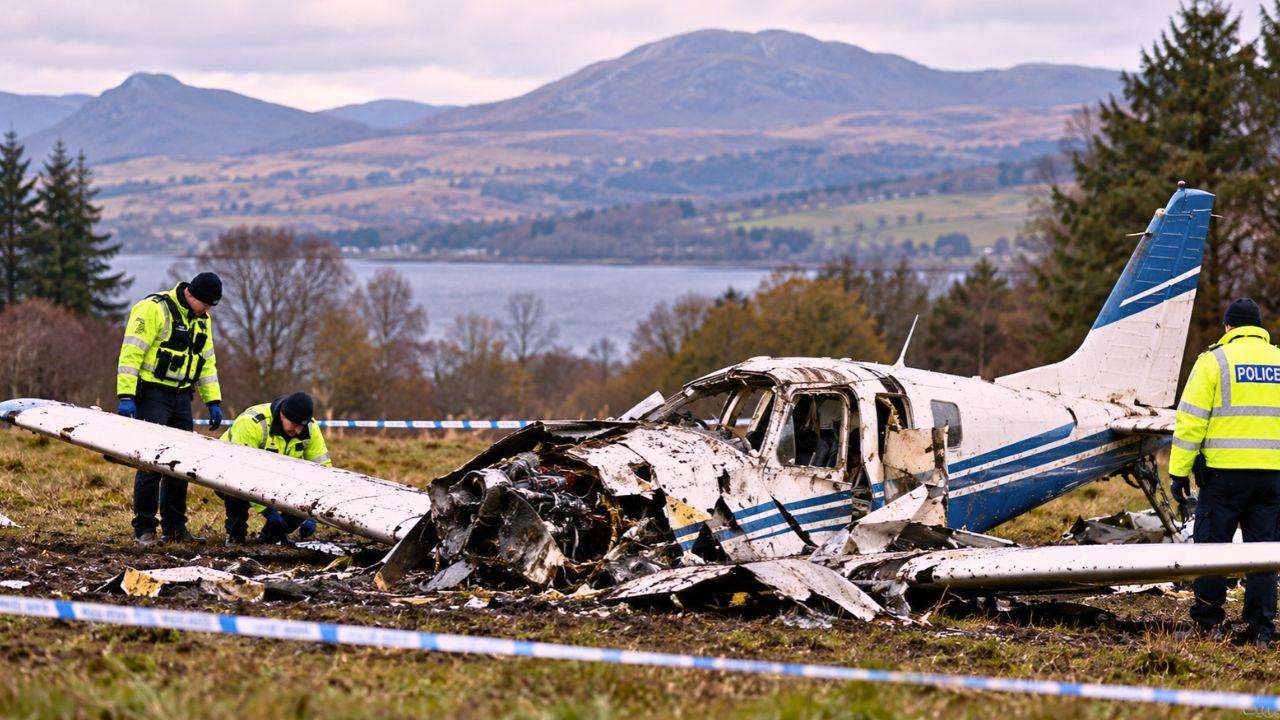
Federal air safety specialists and Police Scotland have widened their inquiry into the fatal light aircraft collision north-east of Drymen, examining whether catastrophic mechanical degradation or inadvertent aerodynamic control failure caused the two-seater trainer to plunge from radar coverage. The late Friday afternoon disaster claimed the lives of an 80-year-old pensioner and a 16-year-old youth when their Piper PA-38-112 Tomahawk II crashed into rural Stirlingshire terrain just 20 minutes into its journey. Flight tracking records confirmed that the aircraft, bearing registration G-LFSU, took off from Glasgow Airport at 4:17pm before suddenly ceasing transponder emissions at 4:37pm, triggering an immediate rural emergency deployment.
Read Also: Two Dead, Including 16-Year-Old Boy, After Light Aircraft Crash in Scotland
Specialist teams from the Air Accidents Investigation Branch have begun forensically documenting the wreckage field near the village perimeter, focusing heavily on whether sudden mechanical malfunction compromised the dual-control aircraft during cruise. Daily Dazzling Dawn understands that investigators are recovering engine components, propeller blades, and fuel systems to establish whether the single Lycoming engine experienced partial or total power loss in mid-flight. Historical safety records from civil aviation authorities emphasize that while total engine cutouts remain infrequent, partial power degradation immediately challenges pilot response options over rugged Scottish countryside, where forced-landing sites are sparse and severe altitude loss occurs rapidly.
The specific flight history of the airframe on Friday has added urgency to the mechanical checks. Records indicate that G-LFSU completed an active multi-leg operational schedule throughout the morning and early afternoon, initially transferring from Cumbernauld Airport to Glasgow Airport before completing a two-hour round trip to Newport-on-Tay in Fife. The trainer then rested on the tarmac at Glasgow for approximately one hour prior to its final 4:17pm departure. The AAIB investigation is cross-referencing pre-flight refueling logs, maintenance histories, and ground handling documentation at both airfields to verify whether latent fuel contamination or airframe fatigue developed during the repeated short-field rotations.
Accident reconstruction specialists are simultaneously assessing whether the disaster stemmed from aerodynamic loss of control or spatial disorientation, two primary contributors identified across general aviation fatalities. The Piper Tomahawk platform, widely deployed across Britain for primary civilian flight training, features a distinctive T-tail configuration that exhibits pronounced spin and stall characteristics under rapid deceleration or turbulent wind shears. Industry safety research published by the Civil Aviation Authority indicates that unintended low-altitude aerodynamic stalls account for nearly half of fatal general aviation collisions, often triggered when a handling pilot reflexively pulls back on the yoke rather than pitching downward to restore wing airflow.
Meteorological data from central Scotland at the time of the crash is also undergoing micro-scale evaluation to determine if localized cloud ceilings, hill turbulence, or sudden visibility drop-offs induced spatial disorientation. Under Visual Flight Rules, any inadvertent drift into low overcast or cloud banks around the southern fringes of the Trossachs can cause rapid vestibular illusions, depriving aviators of horizon references within seconds. Investigators told journalists that neither pilot error nor structural defect has been ruled out, as telemetry teams reconstruct the descent profile from raw radar reflections gathered across Scottish air control sectors.
Police Scotland have fortified an exclusion zone encompassing the crash sector north-east of Drymen, warning that strict airspace prohibitions remain enforced under criminal penalties. The restrictions explicitly ban civilian general aviation and unmanned aerial vehicles to prevent disturbance to ground markers and protect survey operations conducted by AAIB remote sensors. Officers confirmed that family liaisons continue to support the relatives of both the elderly man and the teenage passenger, while formal identification proceedings advance alongside the procurator fiscal.
The AAIB plans to issue an initial factual bulletin outlining flight metrics, maintenance status, and impact signatures within several weeks, with a comprehensive final report detailing actionable safety recommendations expected upon conclusion of laboratory metallurgical tests.



.jpg)