




.svg)
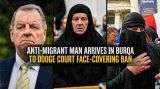
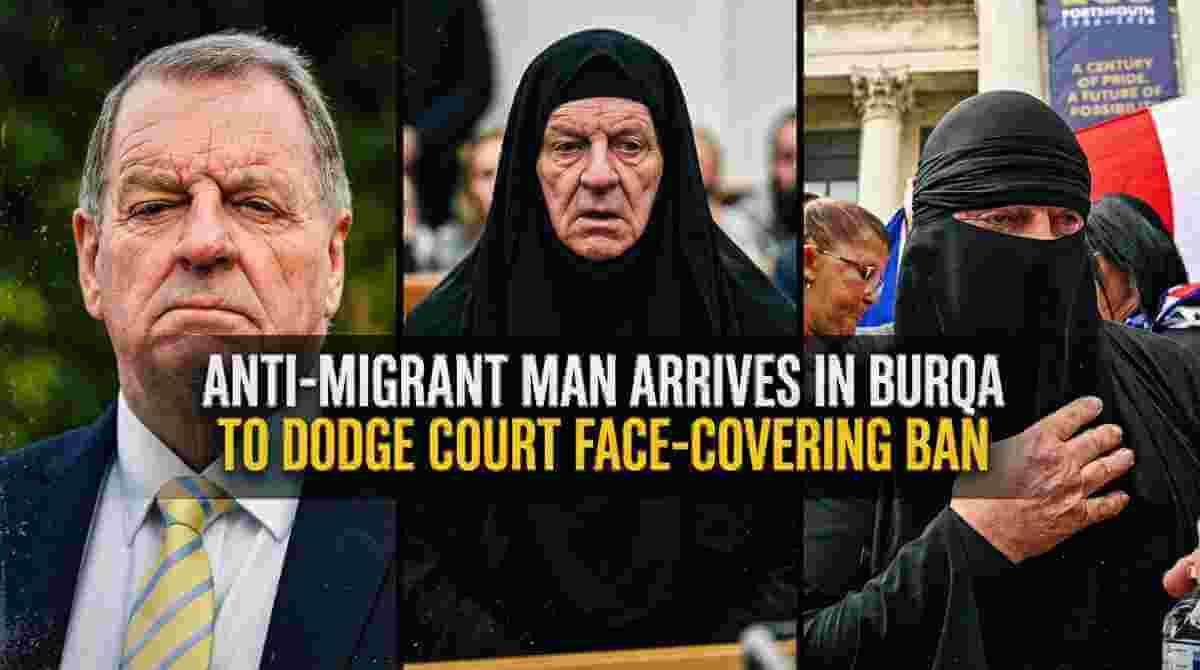
A 76-year-old anti-immigration campaigner has appeared before Portsmouth Magistrates' Court clad in a full Islamic burqa, claiming his appearance formed part of a personal religious conversion to Islam whilst attempting to contest public-order charges. Timothy Miller, a pensioner residing in Hedge End, Hampshire, stood in the dock on Wednesday, 14 October, facing prosecution under statutory public-order provisions for allegedly concealing his identity during a mass demonstration in Portsmouth on 12 September. Wearing the black veil, accompanied by an orange document folder and a handbag, the unrepresented defendant formally entered a plea of not guilty before District Judge Stephen Apted, triggering a scheduled trial on 16 February.
Legal Clashes Over Religious Exceptions-
The courtroom hearing rapidly descended into an extraordinary exchange concerning the genuine nature of statutory religious exemptions versus performative protest tactics. Hampshire Constabulary had enacted emergency powers ahead of the September rally, which drew roughly 2,000 demonstrators to the coastal city following arrivals of cross-Channel small boats, prohibiting participants from wearing face coverings to obstruct identification. Daily Dazzling Dawn learned that Miller was directed to lift his veil briefly for identification confirmation before replacing the garment for the remainder of the legal proceedings. When pressed by District Judge Apted regarding his specific defence against the charge of breaching the prohibition, the defendant insisted that the arrest was unlawful and maintained that the legal system must apply single standards across all communities.
The judiciary challenged the validity of Miller's line of argument, pointing out that general complaints regarding societal parity do not constitute an admissible statutory defence under English criminal law. District Judge Apted reminded the defendant that relying upon a religious dispensation requires tangible, verifiable evidence of genuine faith observance rather than opportunistic claims. In statements heard by the court and reported by Daily Dazzling Dawn, Miller countered that he possessed an inquisitive disposition, arguing that he had commenced studying Islam because he perceived it as advantageous within contemporary British society.
Public Order Powers and Attire Discrepancies-
The confrontation in Portsmouth forms part of a wider pattern of civil disorder and heightened policing interventions surrounding immigration demonstrations across southern England. Hampshire Constabulary imposed the strict ban on facial garments following volatile incidents earlier in the year, including coordinated direct actions where masked activists obstructed strategic arterial routes and port entrances around Dover. Authorities noted that demonstrators had repeatedly deployed balaclavas, scarves, and improvised coverings to frustrate police body-worn video gathering and subsequent prosecutions. Photographic evidence from the September demonstration captured Miller wearing a niqab, a facial veil exposing only the eye area, alongside an abaya, whereas the formal prosecution summons specifically cites the concealment of identity via a burqa, a full-body cloak incorporating a mesh screen over the face.
Throughout his initial court exchange, Miller asserted that police officers failed to request the removal of his facial covering prior to detaining him, an assertion he claimed would be vindicated by police camera evidence. The defendant further recounted past residency in Morocco and travel across Bahrain and Dubai to substantiate his cultural familiarity with Islamic traditions, whilst simultaneously questioning why arriving migrants are not subjected to religious vetting upon entering the United Kingdom.
Scriptural Mandates and Jurisprudential Realities
Miller's legal justification invoking Islamic obligation stands on deeply contested theological ground, as scriptural evidence confirms that face veiling is not a compulsory requirement established in the Quran. Neither the word niqab nor burqa appears within the sacred text as a mandatory command for female believers. The primary Quranic directive concerning female modesty, Surah An-Nur (24:31), instructs women to "draw their head-covers (khumur) over their chests (juyub) and not display their beauty except what is apparent thereof." Mainstream classical scholars across the Hanafi, Maliki, and Shafi'i schools established that "what is apparent" denotes the face and hands, excluding them from the mandatory bodily concealment (awrah). Furthermore, Surah Al-Ahzab (33:59) commands women to "bring down over themselves part of their outer garments (jalabib)" for public recognition and dignity, establishing modest dress rather than a textual decree for facial obscurity. Canonical traditions reinforce this distinction, most notably during the sacred Hajj pilgrimage, where women entering the ritual state of Ihram are explicitly forbidden from veiling their faces.
While overlooking the actual obligatory tenets (fard) of Islam, some Muslims nonetheless interpret the burqa or niqab as a compulsory religious duty. There is now an intense discussion among the younger generation of Muslims regarding how such hardline interpretations are turning Muslims into targets for racists in Britain. By adopting female attire to engineer a confrontation over legal exceptions, Miller's courtroom manoeuvre thrusts a delicate scriptural debate directly into a public-order prosecution.
Trial Preparations and Institutional Implications
Legal commentators indicate that the forthcoming February trial will test the evidential threshold required to claim statutory exemptions for religious apparel during restricted demonstrations. Unrepresented by counsel, Miller informed magistrates that he intends to establish a crowdfunding campaign to finance professional legal representation ahead of the full hearing. District Judge Apted granted unconditional bail until 16 February, formally instructing the defendant that unsubstantiated assertions will carry no evidential weight when the bench evaluates whether the garment served as an authentic religious expression or an intentional contravention of lawful public-order directives.