




.svg)
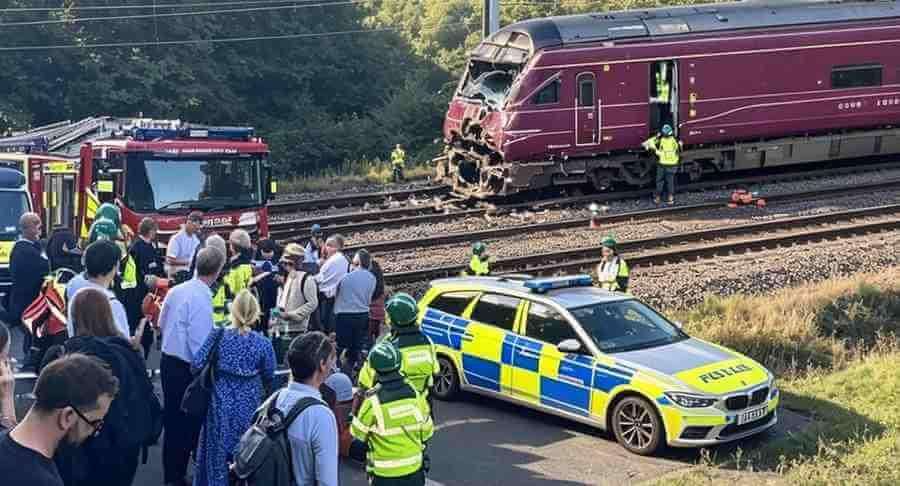
A train driver has tragically died and 89 people have been injured—11 of them left fighting "very serious injuries"—after a high-speed rear-end collision between two East Midlands Railway passenger services forced the declaration of a major incident near Bedford. Emergency service personnel, including hazardous area response teams and multiple air ambulances, are working at pace near Elstow where the 16:40 Corby to London St Pancras service struck the rear of the stationary 15:50 Nottingham to London St Pancras service. Prime Minister Keir Starmer offered his profound condolences to the family of the deceased driver, branding the unfolding disaster as "hugely concerning". The catastrophic impact, which passengers recounted felt like a bomb explosion, has completely paralyzed the Midland Main Line, prompting East Midlands Railway and Thameslink to block all routes between Luton and Bedford for the foreseeable future.
Escalating Casualty Count and Fleet Implications
Hospital sources confirmed that emergency protocols have been upgraded to "all hands on deck" across several departments as regional trauma centers adjust to the influx of the 89 injured passengers. The impact, which occurred just south of the Elstow interchange near the A421 and A6, involved a newly deployed Class 810 electric multiple unit and a Class 360 commuter train. As rescue crews finish clearing the wreckage, Rail Accident Investigation Branch (RAIB) inspectors are specifically probing whether a critical failure of the network's signaling sector or the stationary intercity train's Automatic Warning System (AWS) allowed a secondary service into an occupied block of track.
The focus of a massive emergency response near Bedford has shifted to a formal investigation after the British Transport Police confirmed that one person has tragically died following a high-speed, rear-end train collision on the Midland Main Line. Deputy Chief Constable Stuart Cundy announced that a major incident has been declared as officers work alongside Bedfordshire Police, fire crews, and ambulance services to manage the unfolding crisis. The devastating impact occurred on one of Britain's busiest rail arteries when a moving passenger service struck a stationary, broken-down train from behind near Elstow, raising critical questions about how the network's automated signaling systems failed to prevent the disaster.
Escalating Casualty Count and Fleet Implications
Hospital sources confirmed that emergency protocols have been upgraded to "all hands on deck" across several departments as Bedford Hospital prepares to treat at least 50 casualties. The impact, which occurred just south of the Elstow interchange near the A421 and A6, involved a newly deployed Class 810 electric multiple unit and a Class 360 commuter train. As multiple air ambulances continue to airlift the most severely injured from the tracks, investigators are specifically probing whether the stationary intercity train suffered a critical failure of its Automatic Warning System (AWS)—a system flaw that could raise urgent safety questions for the entire newly integrated fleet.
Escalating Casualty Count and Fleet Implications- Hospital sources confirmed that emergency protocols have been upgraded to "all hands on deck" across several departments as Bedford Hospital prepares to treat at least 50 casualties. The impact, which occurred just south of the Elstow interchange near the A421 and A6, involved a newly deployed Class 810 electric multiple unit and a Class 360 commuter train. As multiple air ambulances continue to airlift the most severely injured from the tracks, investigators are specifically probing whether the stationary intercity train suffered a critical failure of its Automatic Warning System (AWS)—a
Emergency service personnel, including hazardous area response teams and air ambulance crews, spent the evening evacuating hundreds of passengers from the Midland Main Line. The incident occurred when the 16:40 East Midlands Railway (EMR) service from Corby to London St Pancras collided with the rear of the stationary 15:50 Nottingham to London St Pancras service, which had stopped due to an onboard technical failure near Elstow, south of Bedford.
Passengers described a severe impact that caused immediate structural damage to the carriages and left multiple people with significant facial injuries and suspected fractures. Witnesses reported that the moving train did not appear to decelerate or sound a warning horn prior to the impact, which derailed the third carriage of the stationary train. Trade union officials representing onboard staff confirmed that multiple railway employees are among those who sustained serious injuries.
The Rail Accident Investigation Branch (RAIB) has deployed a team of inspectors to the site to preserve evidence and download data from the train protection systems. Parallel tracks remain blocked between Luton and Bedford, with EMR and Thameslink suspending all services to London St Pancras for the remainder of the day while structural engineers assess infrastructure damage.
Legal experts writing for Daily Dazzling Dawn note that the investigation will intensely focus on the sequential data logs of the network's signaling sector, analyzing why the secondary service was permitted into an occupied block of track. Representatives for the train drivers' union expressed deep concern over the system breach, while the Department for Transport stated it is actively working with Network Rail to determine the timeline of the breakdown communications.