

.svg)
The future of the global Islamic economy is no longer being written by population size, but by the speed of digital integration and the removal of institutional friction. While Thailand, a predominantly Buddhist nation, has successfully positioned itself as the "Food Security Hub" for the Middle East through a historic 2026 strategic alliance with Saudi Arabia, Bangladesh—the world's fourth-largest Muslim-majority country—remains a "sleeping giant" unable to wake from its own regulatory nightmares.
The New Halal Ecosystem: Thailand's 2026 Breakthrough
Thailand has officially moved beyond traditional meat exports to pioneer a "New Halal Ecosystem" as of April 2026. A landmark agreement signed recently between the Central Islamic Committee of Thailand (CICOT) and Saudi Arabian authorities has established three transformative pillars: a blockchain-based QR code system for 100% global traceability, the mutual recognition of standards to bypass port delays, and the launch of the "Global Halal Academy." This move is designed to export not just food, but Thai expertise in halal science.
The Thai government's four-year strategic plan is already yielding massive dividends. Beyond the projected $10.27 billion in food exports, Thailand is aggressively capturing the "Muslim-friendly" travel sector. With the "Halal Route" app and new partnerships with Malaysian travel tech firms, Bangkok is successfully converting its status as a top-tier global destination into a safe haven for the $300 billion halal tourism market.
The Bangladesh Paradox: Why a Muslim Giant is Lagging
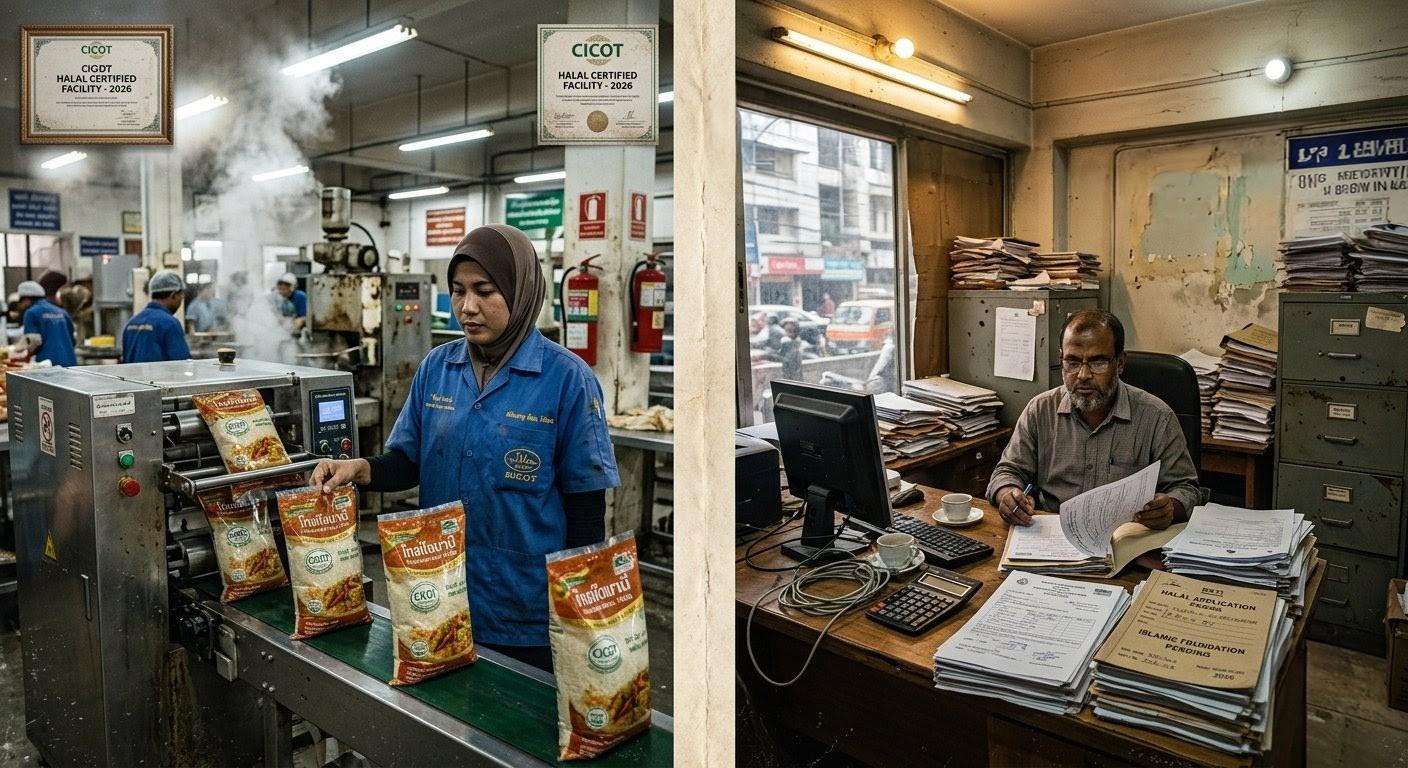
The contrast in Dhaka is stark. Despite a domestic halal market valued at over $125 billion and a fertile agricultural base, Bangladesh’s annual halal exports are currently languishing between $850 million and $1.2 billion—a fraction of its potential. While Thailand’s 7,000 certified companies operate under a single, globally recognised banner, Bangladeshi exporters are currently caught in a paralyzing "turf war."
A persistent dispute between the Islamic Foundation (IF) and the Bangladesh Standards and Testing Institution (BSTI) has left manufacturers burdened by dual certification requirements and regulatory confusion. This institutional fragmentation means that while Thai products flow seamlessly into GCC supermarkets, Bangladeshi goods often fail at the first hurdle of international compliance. Without a unified national authority or "disease-free zones" for livestock, the country’s vast resources remain effectively locked behind its own borders.
The Competition for $3 Trillion
The global halal market is currently valued at $3 trillion and is projected to skyrocket to $9.45 trillion by 2034. In this race, the winners are not necessarily those with the most Muslims, but those with the best laboratories. Thailand’s 2026 focus on "New Productive Forces" and high-end halal meat has allowed it to outmanoeuvre regional rivals.
Specialists told a journalist that Bangladesh’s lack of modern laboratories, skilled manpower, and weak country branding are the primary reasons it captures only 0.04% of the global market. "Our biggest barrier is compliance," an industry leader told a journalist, noting that even a 2% share of the global market could fundamentally rewrite Bangladesh’s economic future as it prepares to exit Least Developed Country (LDC) status.
Looking ahead to the remainder of 2026, Thailand is set to host a high-level EU agri-food mission in May, aimed at blending European quality standards with Thai halal certification for re-export to the OIC. Meanwhile, in Bangladesh, pressure is mounting on the government to resolve the IF-BSTI dispute and establish a single, independent Halal Authority. The window is narrowing; as Thailand scales its "Kitchen of the World" project into a "Digital Halal Hub," the cost of inaction for Bangladesh grows by the billions every month.