





.svg)
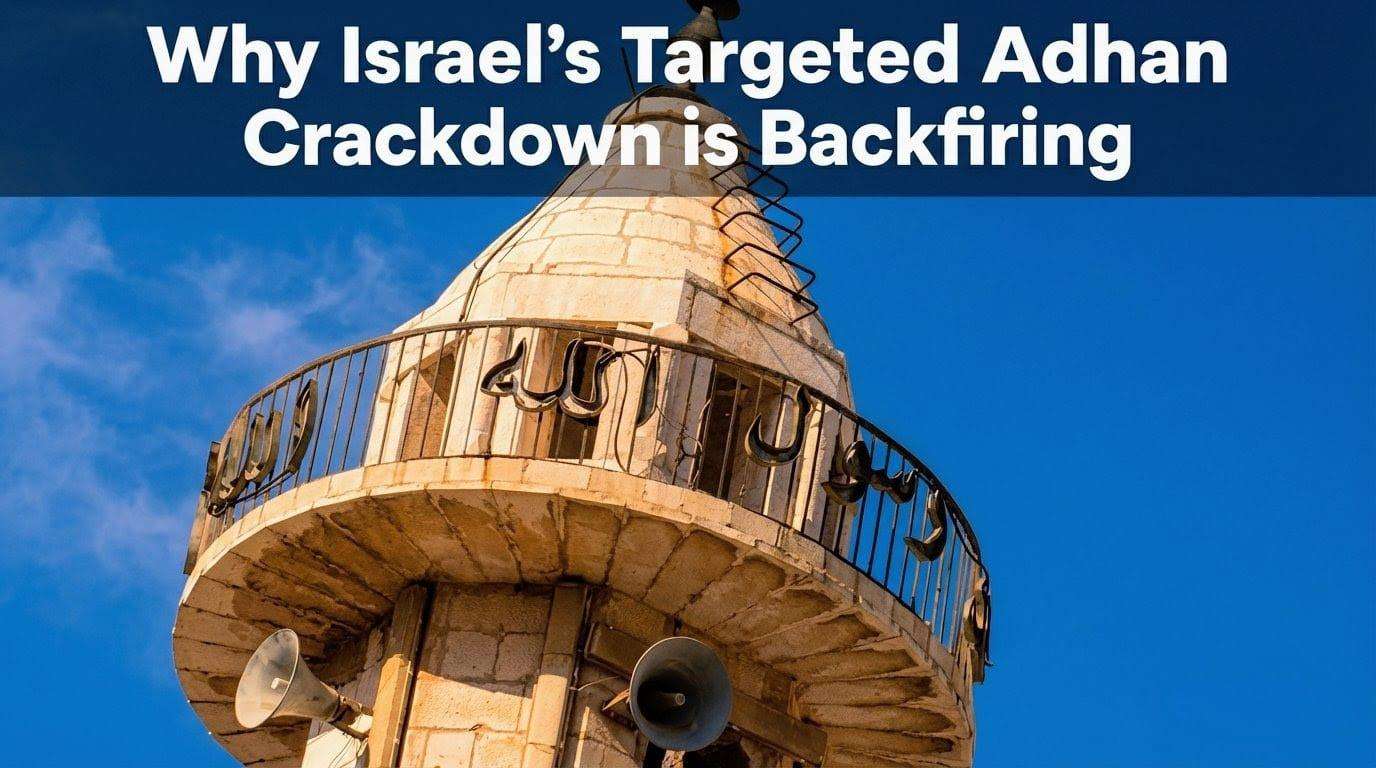
The spiritual heartbeat of the Holy Land is under siege as a calculated political campaign moves to silence the Adhan, the Islamic call to prayer that has echoed across the region for over 1,400 years. What began as a sacred tradition in the 7th century has now been reclassified by state authorities as "noise pollution." While loudspeakers were integrated into the call nearly 90 years ago to serve growing urban populations, they are currently the target of an unprecedented enforcement wave. New data reveals that under the direct orders of National Security Minister Itamar Ben-Gvir, police actions against mosques have skyrocketed by a staggering 1,200% in the last year alone, signaling a transformative shift from administrative regulation to a full-scale assault on Islamic identity.
The Daily Dazzling Dawn Analysis: A Calculated Siege on Spiritual Infrastructure
A deep-dive analysis by Daily Dazzling Dawn reveals that this crackdown is not merely about decibels but about the systematic marginalization of Muslim residents. The financial and psychological damage is extensive. In towns like Tel Sheva, police are no longer just issuing warnings; they are conducting raids to confiscate expensive audio equipment, often leaving mosques with thousands of dollars in property damage and crippling fines of up to 50,000 shekels ($15,000). This "noise-control" strategy effectively serves as a financial blockade, draining resources that mosques use for community welfare and education. The timing of these interventions, often targeting the Fajr (dawn) prayer, is a direct strike at the most tranquil and spiritually significant moment of the day for millions of believers, replacing a message of "God is Greatest" with the presence of state-sanctioned intimidation.
Hypocrisy in Enforcement: The Myth of the "Public Nuisance"
The primary criticism leveled against this policy is its blatant and transparent double standard. While the state cites "quality of life" to justify silencing the Muezzin, it remains conspicuously silent regarding other communal sounds. Church bells, political rallies, and the blaring sirens used to announce the start of Shabbat in Jewish neighborhoods are rarely, if ever, subjected to the same "noise pollution" scrutiny. This selective enforcement proves that the current administration is not protecting the public's ears, but is instead weaponizing the law to erase the Arab and Islamic character of the landscape. Human rights advocates argue that using environmental laws to suppress a 1,400-year-old rite is a "legal subterfuge" for state-sponsored Islamophobia, designed to cater to an ultranationalist electoral base at the expense of social cohesion.
Defiance Through Faith: The Resilience of the Global Ummah
Despite the mounting pressure, the Muslim community in Israel and beyond stands firm in its right to worship. Leaders in the Negev and Galilee have made it clear that the Adhan is an inseparable part of the land’s history—a heritage that predates the very laws now used to suppress it. The international community, including the Organization of Islamic Cooperation (OIC), has begun to take notice of this violation of the fundamental right to religious expression. The attempt to silence the mosques has only served to unify the faithful, as the call to prayer continues to represent a symbol of endurance against a policy that treats the indigenous Muslim population as a nuisance rather than a foundational part of society. The minarets of Tel Sheva may face citations today, but the voice of the Adhan remains an eternal echo that no police decree can truly extinguish.