




.svg)
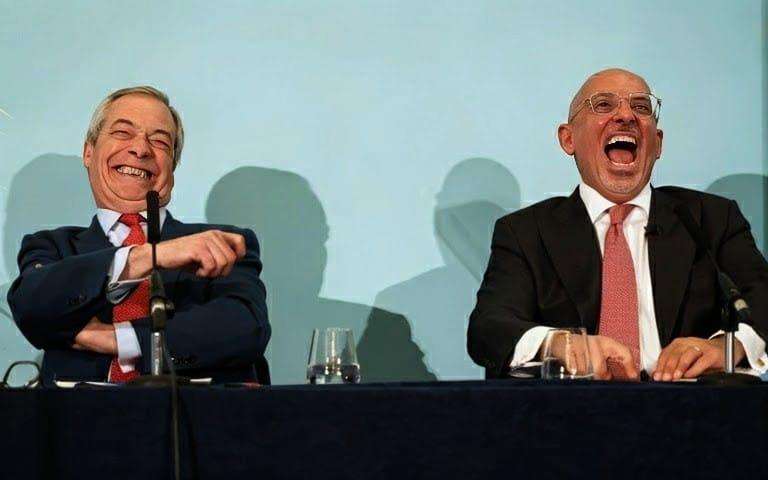
The British political landscape was rocked on Monday morning as Nadhim Zahawi, once the golden boy of the Conservative Party and a former Chancellor of the Exchequer, officially defected to Nigel Farage’s Reform UK. While Zahawi stood shoulder-to-shoulder with Farage, framing the move as a principled stand for a "prosperous Britain," a darker narrative of rejected peerages, tax shadows, and a community feeling abandoned has emerged from the corridors of Westminster.
The Peerage Rejection: Principles or Petulance?
While Zahawi’s public rhetoric focused on "bureaucratic inertia" and "crushing taxes," senior Conservative sources have painted a far more cynical picture. Sources close to CCHQ allege that Zahawi’s "road to Damascus" moment only occurred after he was repeatedly denied a seat in the House of Lords. Insiders claim Zahawi made multiple approaches to Kemi Badenoch’s team, essentially "begging" for a peerage in the December 2025 honors list.
The rejection was reportedly firm. Party leadership felt that elevating a man sacked as Party Chairman for a "serious breach" of the ministerial code—specifically regarding his multi-million-pound tax settlement with HMRC—would be a political suicide mission. To the Tory faithful, this defection isn't a shift in ideology; it's the ultimate act of revenge from a politician whose upward mobility finally hit a ceiling.
The Muslim Community’s Growing Anxiety
Perhaps the most jarring element of Zahawi’s move is his status as one of the most prominent Muslim figures in British politics. His alignment with a party that many in the British Muslim community view as a vessel for Islamophobic rhetoric has sparked a wave of "deep-seated anxiety." Reform UK’s policies, which often target immigration and promote a brand of nationalism that many find exclusionary, stand in stark contrast to Zahawi’s own history.
Critics are pointing to Zahawi’s own words from 2015, when he claimed he would be "frightened to live in a country run by Nigel Farage" and labeled Farage’s views as "racist." His sudden pivot to calling Farage the man to "save Britain" has left many British Muslims feeling that their identity is being used as a shield to legitimize a party they fear. The community now faces the uncomfortable reality of a former leader joining a movement that many believe is indirectly, if not directly, antagonistic toward their presence in the UK.
From Baghdad to the Treasury: The Rise of Nadhim Zahawi
To understand the weight of this defection, one must look at the meteoric rise of the man himself. Born in Baghdad in 1967, Zahawi fled Saddam Hussein’s Iraq as a child, arriving in the UK with nothing. He was educated at the prestigious King’s College School and University College London, where he studied chemical engineering.
Zahawi’s career was a masterclass in the "British Dream." He co-founded the polling giant YouGov in 2000, serving as its CEO until 2010 when he was elected as the MP for Stratford-on-Avon. His political ascent was rapid: from the "Vaccines Minister" who led the UK out of the pandemic to Education Secretary, and finally to Chancellor. Throughout this time, his personal life was anchored by his wife, Lana Saib, and their three children, with whom he shared a passion for horse riding and a sprawling property empire.
The Shadow of Controversy and the Tax Affair
However, the "Baghdad to Westminster" story has been perpetually dogged by financial controversy. The most significant blow came in late 2022 and early 2023, when it was revealed that Zahawi had paid a £5 million settlement to HMRC, including a penalty for a "careless" error regarding shares in YouGov held by an offshore company, Balshore Investments.
This scandal didn't just cost him his job as Tory Chairman; it tarnished his reputation as a "straight-talker." Critics argue that his move to Reform UK is an attempt to outrun these scandals by joining a populist movement that thrives on attacking the "establishment" that ultimately rejected him. By framing himself as a "footsoldier" for Farage, Zahawi is attempting to reinvent himself, even if it means deleting the very tweets where he once stood up against the rhetoric he now embraces.
A Fragmented Right and a Future in Flux
The defection of such a high-profile figure suggests that the Conservative Party is no longer a broad church but a house divided. For Reform UK, Zahawi is a trophy—a sign of "frontline experience" for a party often dismissed as a "one-man band." For the Conservatives, he is a "has-been" looking for a "gravy train."
But for the British public, and specifically the minority communities Zahawi once represented, the move raises a haunting question: in the pursuit of power and a "chair," what happens to the principles of integration and representation that Zahawi once championed so loudly? As the 2026 local elections approach, the impact of this "shock" move will be measured not in headlines, but in the trust—or lack thereof—from a disillusioned electorate.


_3.jpg)