.jpg)
_1.jpg)


.svg)
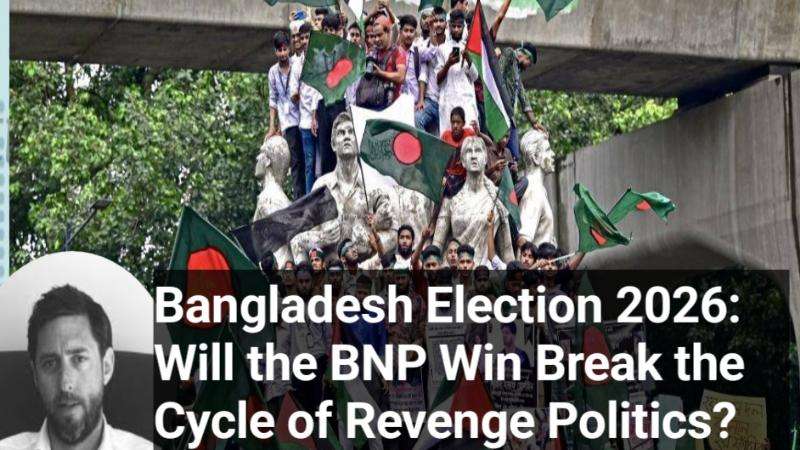
The Nobel Peace laureate, Muhammad Yunus, who took the helm of the interim government following the student-led "Monsoon Revolution," has faced immense pressure to swiftly usher in the vote before Ramadan. The revolution toppled the three-time prime minister Hasina, who had led the Awami League government for 15 years amid accusations of extensive corruption and authoritarianism.
The Referendum on Reform-A central question for the nation is whether the next leadership can successfully implement the restructuring of the electoral, constitutional, and administrative bodies agreed upon by 25 political parties in the "July Charter" of 2025. Public appetite for these sweeping changes will be directly tested in a national referendum to be held concurrently with the general election.
The political landscape is fraught with historical baggage and current tensions. As senior research fellow for South Asia at Chatham House's Asia-Pacific Programme, Chietigj Bajpaee, notes: "What happened last August... was referred to as the country’s second liberation, but I think the reality will be more continuity than change." He warns that there has been little movement towards "genuine national reconciliation," suggesting the "pendulum swinging from one extreme to the other" in the country’s history of often-violent revenge politics. The scale of the turmoil remains sobering: up to 1,400 people died during the crackdown on protests last year, the worst violence since the 1971 War of Independence.
A New Chapter, or the Same Old Script?
Analysts anticipate a likely victory for the Bangladesh Nationalist Party (BNP), led by acting chairman Tarique Rahman, who has spent nearly two decades in exile in London. However, the legitimacy of the vote is already under debate.
In a dramatic sequence of events, Hasina was sentenced to death in absentia in November by a special tribunal court for crimes against humanity related to the protest crackdown, having fled to India hours before demonstrators stormed her residence in Dhaka. Furthermore, her Awami League party has been banned from participating in the 2026 election, a decision that many fear will undermine the entire process.
Naomi Hossain, a professor of Development Studies at SOAS University of London, believes the BNP will win, but cautions that the party is deeply unpopular: "Anyone who remembers them from the early 2000s will recall how violent, thuggish and corrupt they were." The main opposition is expected to be the largest Islamist party, Jamaat-e-Islami.
Economic Headwinds and the Corruption Trap
Beyond the political dynasties, the core challenge remains the deep institutional rot. Bangladesh was ranked 151st out of 180 countries in the Transparency International Corruption Perceptions Index last year. Experts contend that during Hasina’s 15-year rule, many once-independent institutions—including the civil service, police, military, and media—were effectively captured and hollowed out by the government’s authoritarian leanings.
The current political transition appears to be continuing this pattern. Bajpaee highlights the danger: "Under the previous Hasina government, we saw the persecution of BNP and Jamaat-e-Islami, and now we’ve seen a purge of the Awami League." This raises the crucial question: "How do you break this cycle?"
Economically, the situation is precarious. Growth has slowed since the COVID-19 pandemic, and the country’s reliance on importing all its energy makes it vulnerable. The incoming government will inherit a challenging fiscal environment. As Professor Hossain concludes, the new administration will have "very little fiscal space to help the poor and rebuild the economy." The only likely restraint on potential corruption and "crony capitalism," regardless of which entrenched dynasty takes power, is the grim possibility of yet another popular uprising.
(Analysis of Bangladesh's February 2026 general election: will the vote under the interim government, led by Muhammad Yunus, deliver a 'democratic reset,' or will economic instability and the enduring, violent cycle of 'revenge politics' lead to a return to the corrupt past? Featuring expert insights from Chatham House.)