




.svg)
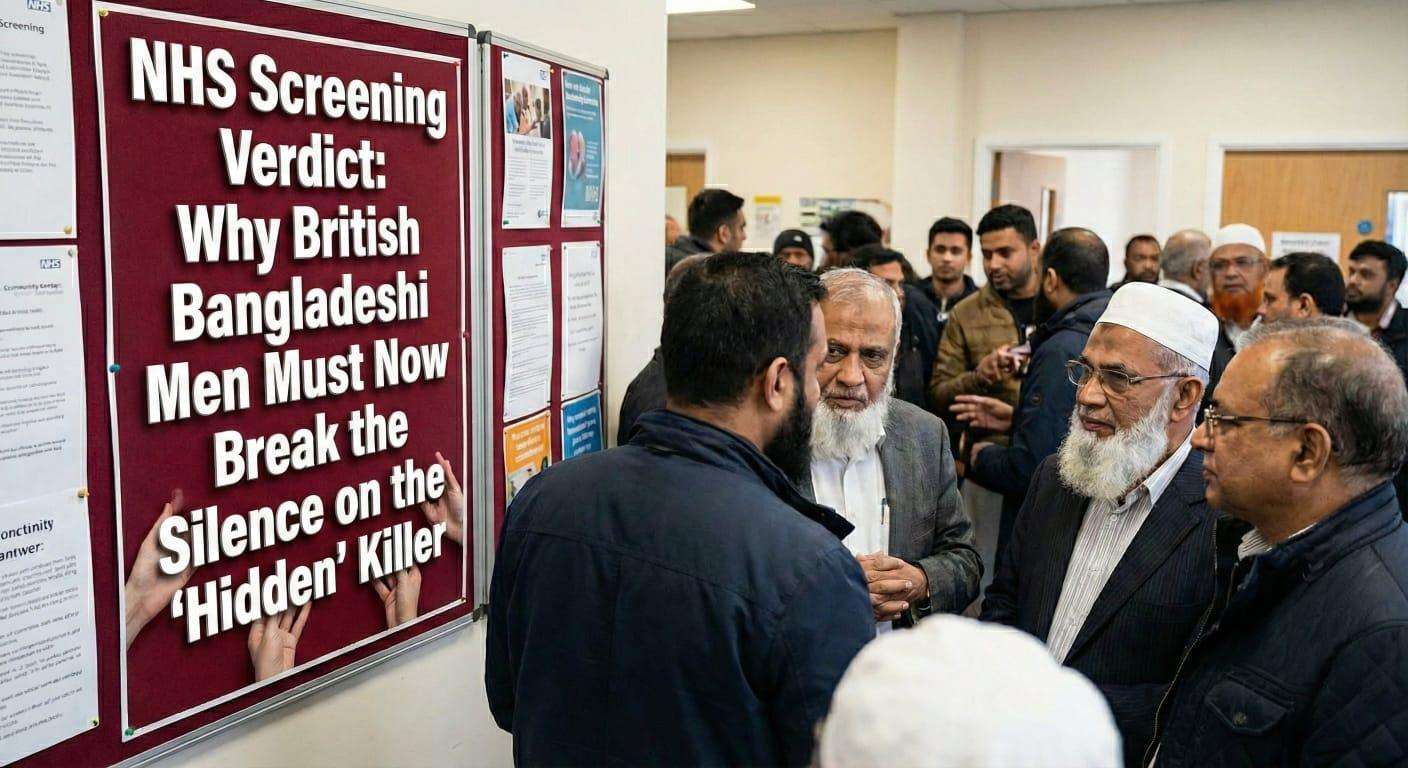
A potentially life-saving safety net has been withdrawn before it was even deployed. In a move that has sparked intense debate across the medical and political spectrum, NHS advisers from the National Screening Committee (NSC) have issued a draft ruling against rolling out mandatory prostate cancer testing for men aged 45 to 70. While the headline figures suggest a national setback, for the British Bangladeshi community, this decision signals a more complex and silent crisis lurking in the shadows of our healthcare system.
The NSC’s rejection of a mass screening programme—citing concerns that current PSA tests are unreliable and could lead to "needless harm" through over-treatment—leaves the onus of diagnosis entirely on the individual. For British Bangladeshi men, who statistically face unique cultural barriers and systemic healthcare inequalities, this "wait and see" approach could prove fatal.
The "Low Risk" Trap
The current medical consensus is set to pivot toward "targeted screening," focusing resources on those deemed highest risk: Black men (who face a 1 in 4 lifetime risk) and those with specific genetic mutations. On the surface, this data seems to suggest British Bangladeshi men are safer; statistics indicate a risk of roughly 1 in 13, lower than both White (1 in 8) and Black men.
However, community health leaders fear this statistical "safety" will breed complacency. If targeted screening campaigns focus exclusively on the "high risk" demographics, British Bangladeshi men risk falling into a dangerous visibility gap—too "low risk" to be actively chased by the NHS, yet facing a disease that becomes deadly when ignored.
The danger is compounded by the fact that while incidence rates may be lower, the mortality rate is often driven by late diagnosis. For a community where health concerns are often private and discussing intimate bodily functions remains a significant cultural taboo, the lack of a proactive invite from a GP means many men will simply suffer in silence until it is too late.
A Postcode Lottery of Survival
The decision to deny mass screening exacerbates an existing "postcode lottery" that disproportionately affects British Bangladeshi households. The ruling acknowledges that uptake of voluntary testing is far higher in affluent, predominantly White areas, while death rates spike in deprived regions.
In areas with high Bangladeshi concentrations, such as Tower Hamlets, Oldham, or parts of Birmingham, the combination of socio-economic deprivation and a lack of proactive screening creates a perfect storm. Without a mandatory programme, the system relies on men marching into a GP surgery and demanding a test—a behaviour that contradicts the cultural norm of many first-generation elders who view doctors with deference and rarely question medical authority or request unprompted checks.
Political Backlash and The Hope for Change
The ruling is not yet set in stone. The draft recommendation is currently under a 12-week consultation period, and Health Secretary Wes Streeting has indicated he is willing to challenge the advisers. Streeting, recognizing the severity of the issue, has stated he intends to "thrash out" the arguments, emphasizing that the current draft is "the first step, not the conclusion."
He faces mounting pressure from a cross-party alliance of 125 MPs, led by former Prime Minister Rishi Sunak, who are demanding a "legacy-defining advance" in men’s health. They argue that elected representatives must weigh the risks and benefits rather than simply rubber-stamping advisory board decisions. High-profile figures like Sir Chris Hoy, recently diagnosed with terminal prostate cancer, serve as tragic reminders that fitness and lack of symptoms are no guarantee of safety.
The New "TRANSFORM" Trial
There is a glimmer of hope on the horizon. A massive new £42 million trial named TRANSFORM is currently recruiting. This study aims to recruit hundreds of thousands of men to test new screening methods specifically designed to be more accurate than the standard PSA test. Crucially, this trial is actively seeking diversity to ensure BAME communities are not left behind by medical science again.
What British Bangladeshi Men Must Do Now
The NHS will not come to you, so you must go to the NHS. The ruling against mandatory screening does not mean you are banned from testing. It simply means your GP will not automatically invite you.
If you are over 50—or over 45 with a family history of cancer—you have the legal right to request a Prostate Specific Antigen (PSA) test from your GP. Do not wait for symptoms. By the time symptoms appear—such as difficulty urinating, needing to rush to the toilet at night, or blood in the urine—the cancer may have already spread.
Your Action Plan:
Step 1: Book a GP appointment specifically to discuss prostate health.
Step 2: overcome the awkwardness. Tell the doctor, "I know there is no screening programme, but I am concerned about my risk and would like a PSA test."
Step 3: Spread the word in the community. Talk to fathers, uncles, and brothers after Friday prayers or at family gatherings. The silence is the virus that allows the cancer to thrive.
The government may have paused the screening rollout, but the British Bangladeshi community cannot afford to pause its vigilance.