






.svg)
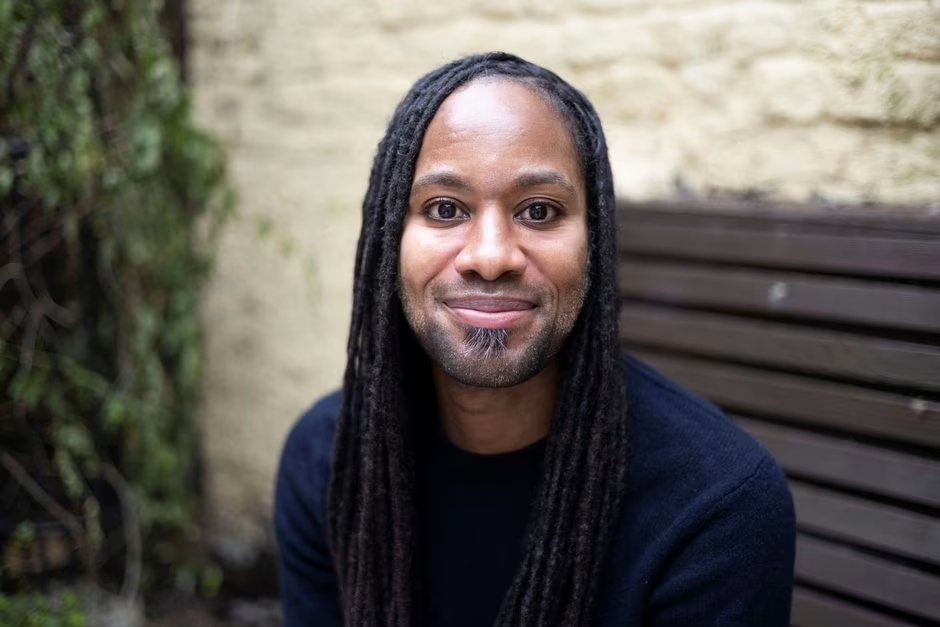
Former University of Cambridge sociologist Professor Jason Arday has been found dead at his south-west London home aged 41, with police confirming his sudden passing is being treated as unexpected but non-suspicious. The tragedy follows an intense period of scrutiny surrounding academic plagiarism allegations and personal claims, prompting his grieving family to condemn what they described as a devastating campaign of misinformation and harassment.
Jason Arday, who made history in 2023 as the youngest Black scholar appointed to a full professorship at the University of Cambridge, was discovered unresponsive at an address on Daley Thompson Way in Battersea on Friday afternoon. Emergency responders from the London Ambulance Service, including an advanced paramedic and specialists from the Hazardous Area Response Team, were dispatched alongside the Metropolitan Police shortly after three o'clock, where the forty-one-year-old sociologist was pronounced dead at the scene.
The exact medical cause of death has not been established, and officers from the Central South Command Unit are conducting an investigation to prepare a formal file for HM Coroner. Metropolitan Police officials have reiterated that while the death is treated as unexpected, there are no initial indications of suspicious circumstances.
A Meteoric Rise Amid Extraordinary Adversity- Professor Arday's appointment as Professor of Sociology of Education at Cambridge and a Fellow of Jesus College was celebrated internationally as a milestone for diversity in higher education. Diagnosed with global developmental delay and autism spectrum disorder in early childhood, he was non-verbal until the age of eleven and did not learn to read or write until eighteen. His remarkable trajectory saw him transition from a physical education teacher to holding chairs at the University of Glasgow and subsequently Cambridge.
Beyond his sociological research into educational inequalities and institutional racism, Professor Arday earned widespread public admiration for personal endurance challenges, raising millions of pounds for charitable causes. However, aspects of his academic record and public claims—including assertions of running 600 miles in six days and the exact nature of his childhood developmental milestones—became the focal point of escalating media scrutiny in recent months.
The Plagiarism Row and Resignation- The institutional crisis intensified when national reports alleged that his 2015 doctoral thesis, completed at Liverpool John Moores University, contained extensive unattributed passages from earlier academic works. While an earlier review by Liverpool John Moores University cleared him of bad faith wrongdoing, Cambridge subsequently confirmed it would launch an independent inquiry into the faculty appointment procedures that led to his hiring.
On 5 August, Professor Arday submitted his formal resignation. In a poignant open resignation letter, he conveyed that while he acknowledged clerical errors in his doctoral work, stepping down was the only way to shield his family and colleagues from unrelenting pressure. He stated that his departure should not be seen as an acceptance of the hostile narratives surrounding him, writing that he had simply reached the absolute limit of what any individual could reasonably endure.
Grieving Family Condemns Misinformation Campaign- Following the announcement of his death, Professor Arday’s family released an emotional statement through his publisher, Simon & Schuster UK, describing their profound shock and devastation at losing a beloved father, partner, brother, uncle, and son. The family stated that the prolonged campaign of misinformation and harassment proved too much to bear for a gentle man who always sought to see the good in others, appealing urgently for privacy.
The tragedy has prompted an outpouring of grief across Westminster and British academia. Education Secretary Lucy Powell stated she was deeply shocked and saddened by the news, urging the public to remember the real people and loved ones at the heart of such stories. Cambridge Vice-Chancellor Professor Deborah Prentice expressed heartfelt sorrow, extending the university's deepest condolences to his family, while academics nationwide continue to pay tribute to his mentorship and warmth.
Whatever you are going through, support is available. You can call the Samaritans free at any time on 116 123 in the UK, or email jo@samaritans.org.



.jpg)