





.svg)
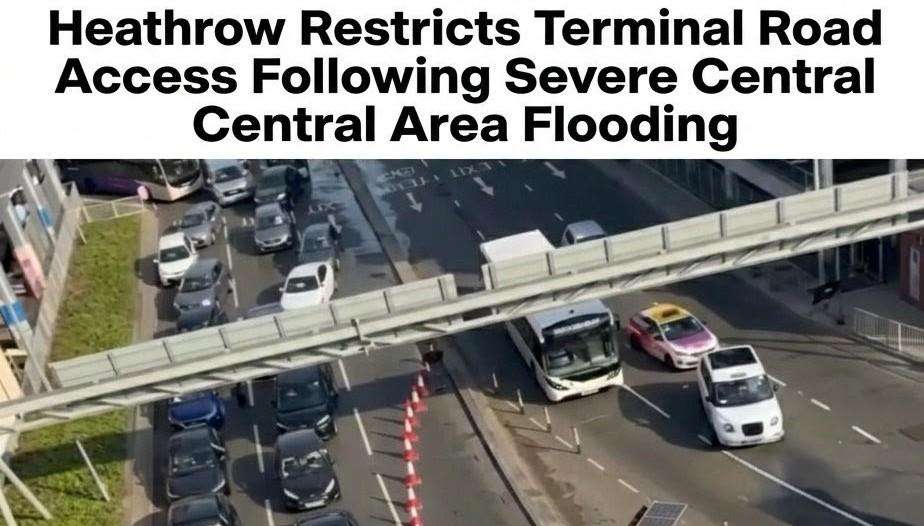
A burst water main beneath Inner Ring Road West has flooded Heathrow Airport's central terminal area, severely restricting vehicular access to Terminals 2 and 3 on Saturday. Airport officials have advised outbound and arriving travellers to bypass road networks entirely and use the Elizabeth line, Piccadilly line, or Heathrow Express while flight operations continue unaffected.
Severe Road Disruption Hits Central Terminal Area
A major infrastructure failure severed primary road access to London Heathrow Airport’s Terminals 2 and 3 on Saturday morning, 15 August 2026, after a ruptured water pipe inundated the airport's central terminal area. Ground management teams issued an urgent travel advisory instructing all departing and arriving passengers to avoid private vehicles, taxis, and ride-hailing services around the affected zone.
The disruption stems from a significant subterranean leak situated beneath Inner Ring Road West, which quickly pushed floodwaters across the principal road arterial connecting the central hub. While road transit remains severely hindered, Daily Dazzling Dawn understands that internal terminal facilities remain completely dry and scheduled flights continue to operate without operational delays.
Urgent Transit Guidance for Summer Holiday Travellers
Airport operational command has directed travellers heading to Terminals 2 and 3 to rely exclusively on direct railway and London Underground links. Transport authorities have confirmed that the Piccadilly Line, the Elizabeth Line, and the dedicated Heathrow Express network are operating regular timetables directly into the central stations.
For motorists who must arrive by private vehicle, the airport authority has advised diverting towards long-stay Park and Ride facilities or routing directly to Terminals 4 and 5. From those outlying terminals, passengers can transfer onto free inter-terminal rail connections to reach their check-in desks. Specialized engineering crews remain on-site at Inner Ring Road West to pump out standing water and isolate the damaged pipework, with emergency logistics teams attempting to restore standard vehicular capacity before peak afternoon travel windows.
Peak Season Congestion Compounds Travel Strain
The transport disruption coincides with the absolute peak of the British school summer holiday season, traditionally representing the most congested operating period across the United Kingdom's aviation network. Heathrow recorded its highest single-day passenger volume of the year on 19 July, when more than 267,000 travellers passed through security checkpoints. Saturday’s road closures have consequently placed substantial passenger flow burdens on the airport’s subterranean rail concourses and internal transit corridors.
Ground staff and customer assistance teams have been deployed across key transport interchanges to manage passenger density and redirect arriving drivers toward alternative drop-off points. Airline operators have encouraged ticket holders to factor in considerable journey buffers to ensure they clear mandatory security screenings in time for their departures.
Wider Infrastructure Pressures and Long-Term Capital Investment
The unexpected burst main arrives during an intensive period of scrutiny regarding long-term infrastructure resilience and capital funding at Britain's hub airport. The Civil Aviation Authority recently authorised Heathrow Airport Limited to recover up to £320 million in preliminary planning expenses related to its proposed third runway development scheme.
Under the approved regulatory framework, these planning outlays will be recouped across a 20 to 25 year horizon through airline charges, a mechanism projected to raise per-passenger regulatory fees by roughly 15 pence in 2028 before scaling to an estimated 30 pence in later years. The wider expansion programme, estimated at £33 billion, remains framed as an entirely privately financed project without direct taxpayer contributions, intended to modernise airfield infrastructure, build replacement facilities, and expand overall annual capacity.
Daily Dazzling Dawn learned that emergency coordination units will maintain active traffic diversions throughout Saturday afternoon while water utility contractors finish repairs on the primary main beneath the central roadway. Passengers scheduled to fly from Terminals 2 and 3 are urged to check digital airline portals and live transport feeds before departing home.