






.svg)
Donald Trump declared his first year back in office a major achievement during Tuesday night’s State of the Union address, despite facing low approval ratings ahead of November’s midterm elections, where Republicans risk losing control of Congress to Democrats.
The speech, delivered to a joint session of Congress, followed months of political turbulence. His administration has faced criticism over a controversial immigration crackdown in Minneapolis that led to the deaths of two U.S. citizens, along with limited progress on reducing living costs — a key campaign promise.
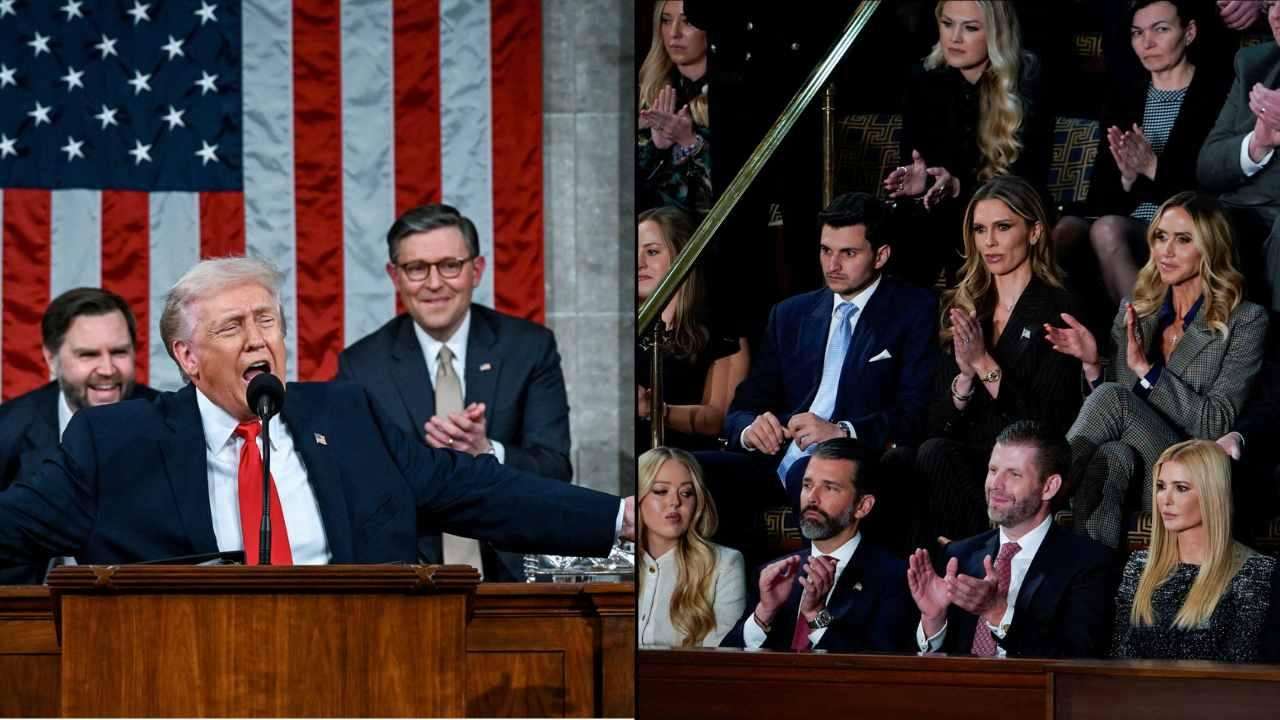
Although several Democrats protested during the address — some walking out, holding signs, or verbally challenging him — Trump struck a confident and celebratory tone. He claimed his leadership had restored a nation he described as damaged under Joe Biden. Lasting nearly two hours, the address became the longest State of the Union speech on record and featured surprise guests meant to symbolize what he described as America’s renewed strength.
Trump stated that within just one year, his administration had delivered unprecedented transformation and historic recovery. He insisted the country would not return to its previous condition.
However, recent polling suggests many Americans remain unconvinced. A Washington Post–ABC News–Ipsos survey found only 39% of voters view his presidency favorably, with many expressing dissatisfaction regarding economic management and immigration policies.
UK Retail Sales Bounce Back Unexpectedly
Throughout the speech, Trump avoided addressing negative public sentiment. Instead, he highlighted what he described as achievements, though critics noted the speech contained exaggerations and limited new policy proposals. He announced that Vice President JD Vance would spearhead a new anti-fraud initiative and said he had secured a “ratepayer protection pledge” aimed at shielding households from rising electricity costs linked to new data centers.
Trump also repeated disputed claims, including incorrectly alleging that an immigrant killed a Ukrainian refugee in North Carolina — despite reports identifying the suspect as a U.S. citizen. He further pledged continued protection for Medicaid, even though recently signed legislation includes cuts projected to impact millions of beneficiaries.
Several Supreme Court justices attended the speech. Three — John Roberts, Amy Coney Barrett, and Elena Kagan — had recently supported a ruling limiting Trump’s executive authority to impose tariffs. While expressing disappointment with their decision, Trump’s criticism of the court remained measured.
Scottish Sikh Activist Jagtar Singh Johal Granted Bail After Almost Nine Years in Indian Custody
In contrast, he used stronger language when referring to Democratic lawmakers and Somali immigrants in Minnesota, describing Democrats as “crazy” and characterizing immigrants involved in local controversies as destructive. Though he has increased military presence near Iran, Trump offered limited details about future strategy, stating he prefers diplomacy but would not allow Iran to obtain nuclear weapons.
Much of the address focused on honoring invited guests seated in the gallery, including Olympic gold medalists, a National Guard member who survived a shooting, a Korean War veteran awarded the Medal of Honor, and a wounded helicopter pilot involved in a January operation targeting Venezuelan president Nicolás Maduro.
Trump concluded with a declaration that America is “winning again” at unprecedented levels.
Democrats who remained largely withheld applause in what party leaders described as silent protest. Some stood only for bipartisan topics such as the release of Israeli hostages and proposals to restrict stock trading by lawmakers. Others skipped the event entirely, participating instead in alternative events like a “People’s State of the Union.”
Representative Al Green of Texas briefly held up a protest sign referencing a past controversy involving Trump sharing a racist video. After exchanges with Republicans, he was escorted from the chamber.
Several lawmakers shouted objections during the speech. Minnesota congresswoman Ilhan Omar accused Trump of responsibility in connection with recent deaths in her state. Others, including Senator Mark Warner of Virginia, left before the speech concluded, citing frustration with what they described as misinformation.
House Democratic leader Hakeem Jeffries criticized the address afterward, accusing Trump of spreading falsehoods and failing to present a constructive vision for the country’s future.
The speech served as a significant moment ahead of the midterms. Republicans currently hold narrow majorities in both chambers of Congress. While Democrats failed to prevent Trump’s return to the presidency in 2024, they have found encouragement in recent special and off-year election victories, which may signal competitive races ahead.
Virginia Governor Abigail Spanberger delivered the official Democratic response. In her remarks, she questioned whether the president’s policies truly benefit everyday Americans, criticizing his tariff strategy and immigration enforcement tactics, and concluding that many Americans believe the answer is no.

_1.jpg)