





.svg)
Cash Cow or Public Service? London Councils Face Scrutiny Over Parking Fine 'Abuse'-London drivers are increasingly vocal about what they perceive as systemic abuse of the parking fine system by local councils, arguing that the enforcement has shifted from maintaining traffic flow to generating maximum revenue. New data on Penalty Charge Notice (PCN) issuance reveals a growing trend of aggressive ticketing, frequently leading to confusion, distress, and allegations of injustice, despite several high-profile fines being overturned on appeal, Daily Dazzling Dawn understands.
The latest figures paint a stark picture: London boroughs are reportedly collecting record sums from parking fines, leading critics to dub the system a municipal "cash cow." With councils heavily relying on this income stream, the focus on enforcement efficiency appears, for many drivers, to have superseded fairness and clear communication.
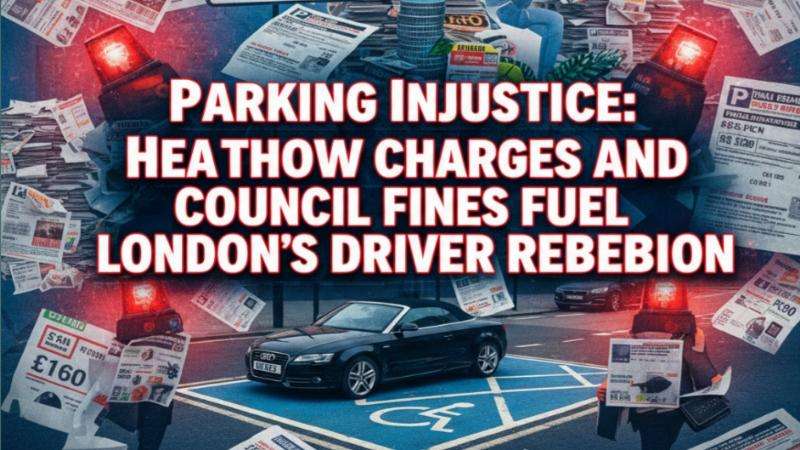
Bizarre Enforcement: The Croydon Case That Shocks Drivers-The narrative of council overreach was dramatically underlined by the recent case involving driver Silva Stone and Croydon Council. Stone had legally parked his black Audi convertible on a New Addington street, believing the spot to be restriction-free. In a truly bizarre turn of events, a Croydon Council road-marking team proceeded to paint a new disabled parking bay around his vehicle.
Footage posted by Stone showed the contractors completing the bay on November 17th, with the car still occupying the newly marked space. Despite the council's own contractor being fully aware of the car's presence—a fact documented by an internal photo—a breakdown in communication led to a traffic warden issuing a staggering four separate £160 PCNs between November 22nd and 26th.
Stone, who branded the incident as a profit-driven "bullying" tactic, found himself facing a potential £640 bill for parking legally. Although Croydon Council later confirmed the fines would be cancelled, acknowledging the warden was "not informed" of the situation, the incident has become a viral symbol of the communication failures and heavy-handed approach drivers believe is plaguing London’s parking enforcement. A council spokesperson apologised for the confusion, yet the core issue of the right hand not knowing what the left is doing remains a significant concern for the public.
Airport Charges Under the Microscope: The Heathrow Hotspot-The controversy surrounding enforcement extends beyond residential streets and into the transport hubs, with London's major airports becoming new hotspots for punitive charges.
The focus is currently sharpest on Heathrow Airport, following its implementation of the £5 Ultra Low Emission Zone (ULEZ)-style Terminal Drop-Off Charge. While the charge itself aims to reduce congestion and improve air quality, the subsequent enforcement has drawn criticism. Drivers are being caught out by complex payment systems and short deadlines, leading to rapid escalation of fines. Unpaid 5 charges can quickly spiral into 80 penalties, reduced to £40 if paid within 14 days, with drivers often reporting they were unaware of the payment requirement or that signs were unclear.
While no other major London airport has recently introduced a similar non-refundable access charge, Gatwick and Stansted maintain their own drop-off charges £6 for 10 minutes at Gatwick; £7 for 15 minutes at Stansted), and the penalties for non-compliance are equally swift and financially damaging. The consistent thread across both council and airport enforcement is the speed at which a minor infraction or a simple administrative error can result in a triple-figure fine, feeding the perception that the primary objective is financial return.
As councils defend their enforcement as necessary for road safety and traffic management, the growing catalogue of cancelled fines and public outcry suggests a system that is fundamentally flawed, prioritizing aggressive ticketing over procedural justice and clear public guidance. Drivers, demanding better communication and accountability, are urging an overhaul of the fine system before the relationship between motorist and council deteriorates further.